

Biblical Dream Symbols: An A-to-Z Guide
A grounded A-to-Z guide to biblical dream symbols, from Joseph and Daniel to serpents and water, and why Scripture never gives one fixed symbol dictionary.
 Featured
The Bible contains important dreams and visions, but it does not give one fixed code for every modern dream symbol. A biblical reading begins with the relevant passage and its context, then holds the dream with humility rather than treating an online symbol list as certainty. The same image, a serpent or a flood or a stairway, carries different meanings in different passages, so the honest starting point is the text, not a dictionary.
Key Takeaways
No fixed code
Scripture never provides a universal A-to-Z where each symbol has one meaning.
Context first
A biblical image means what its passage and its genre make it mean, not what a word search suggests.
Belief, not prediction
Every symbol reading here is tradition and reflection, never a forecast about your life.
Same image, two roles
A serpent means temptation in one text and healing in another, which is the whole point.
Discernment matters
Christian traditions differ, and the Bible never tells readers to treat every dream as a message.
A dream cannot override Scripture
A dream that contradicts a person's faith or values is not treated as authority.
01Dreams and visions in Scripture
The Bible takes dreams seriously in specific moments, which is why the topic feels weighty to readers who grew up with these stories. Some of the most consequential turns in the biblical narrative arrive while someone is asleep.

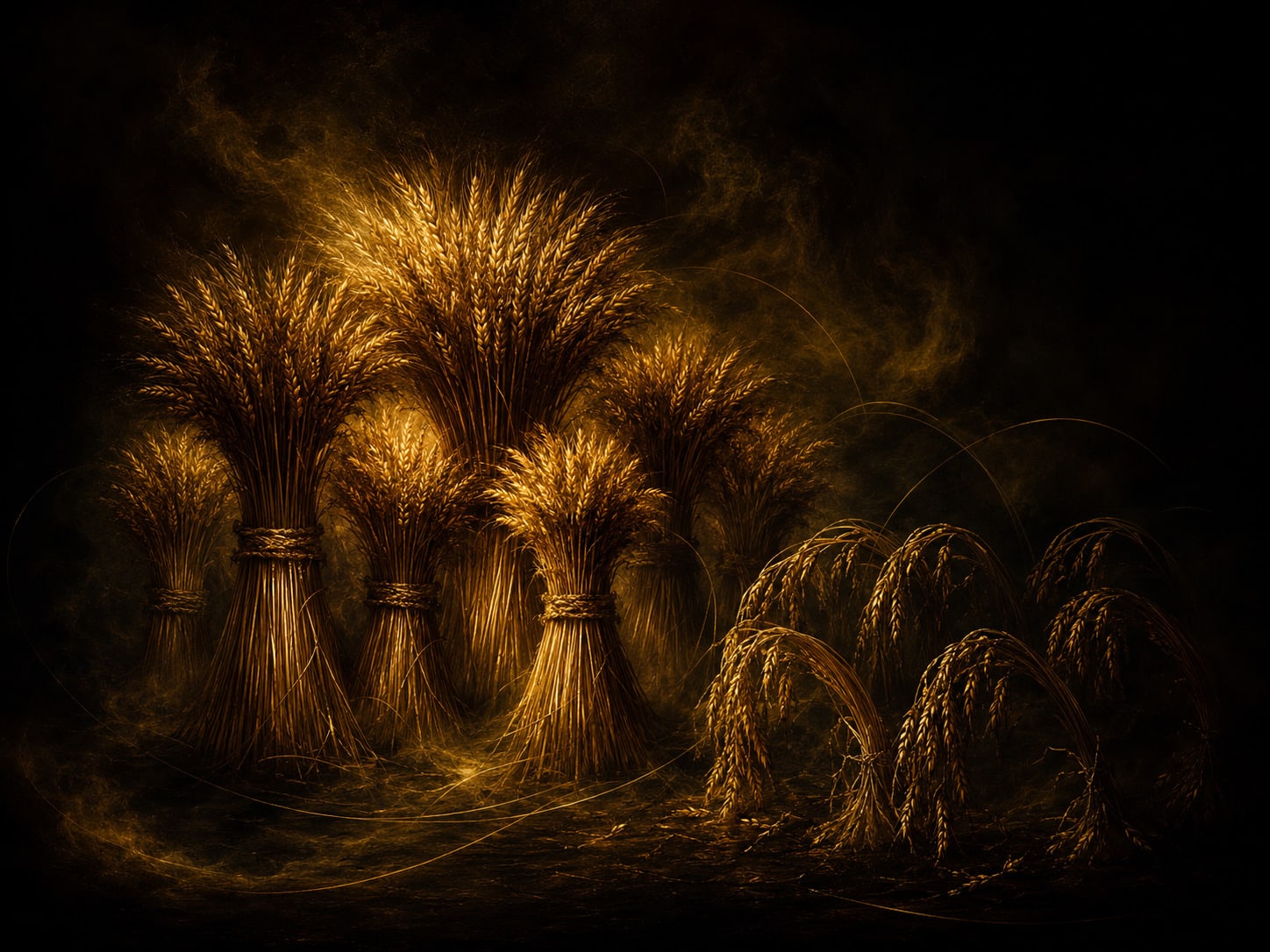
Joseph is the clearest example. In Genesis 37 he dreams that his brothers' sheaves of grain bow down to his own, and then that the sun, moon, and eleven stars bow to him. His brothers respond with escalating jealousy and hatred, and the text says his father rebuked him but "kept the matter in mind." Years later, in Genesis 41, Joseph interprets Pharaoh's twin dreams of seven fat cows and seven lean cows, and seven full heads of grain and seven withered ones, as seven years of plenty followed by seven years of famine. He adds that the dream came in two forms because "the matter has been firmly decided by God." Notice that even here the meaning is not read from a symbol chart. It is disclosed within the story.
Daniel plays a similar role for a foreign king. In Daniel 2, when Nebuchadnezzar demands that his dream be both recalled and explained, Daniel tells him plainly that no wise man, enchanter, or diviner can do it, but that "there is a God in heaven who reveals mysteries." The point Daniel presses is that interpretation is not a human technique. It is not a decoder ring.
Other dreams shape the story without a formal interpretation at all. In Genesis 28 Jacob dreams of a stairway resting on the earth with its top reaching to heaven and angels ascending and descending on it, and he wakes calling the place "the house of God" and "the gate of heaven." In 1 Kings 3 God appears to Solomon at Gibeon in a dream and offers, "Ask for whatever you want me to give you," and Solomon asks not for wealth or long life but for "a discerning heart" to govern well. The New Testament keeps the thread. In Matthew's opening chapters, Joseph the husband of Mary is repeatedly warned and guided in dreams. In Matthew 27:19 Pilate's wife sends word during the trial: "Don't have anything to do with that innocent man, for I have suffered a great deal today in a dream because of him." In Acts 10 Peter sees a sheet lowered with all kinds of animals and hears a voice say "Kill and eat," a vision that is explained as God removing the barrier between Jew and Gentile rather than as a lesson about food. In Acts 16 Paul sees a man of Macedonia begging, "Come over to Macedonia and help us," and the group concludes God is redirecting their journey.
Two things stand out across all of these. First, the dreams matter because of what the passage says they mean, not because the images carry stable meanings on their own. Second, they are rare, pivotal events tied to specific people and moments, which is very different from treating any ordinary night's dream as a message.
02Why there is no biblical symbol dictionary
This is the honest center of the whole subject. Many online guides present a tidy list in which a snake always means an enemy, water always means the Holy Spirit, and a house always means your life. Scripture does not work that way, and reading it that way produces confident, wrong conclusions.
The serpent is the cleanest proof. In Genesis 3 the serpent is the tempter, tied to deception, and its line about striking at the heel is where much of the snake-as-hidden-adversary association begins. Yet in Numbers 21, when "fiery serpents" bite the grumbling Israelites and many die, Moses is told to make a bronze serpent and lift it on a pole, and anyone who was bitten and looked at it lived. The very same creature is temptation in one passage and an image of looking up toward healing in another. A fixed dictionary cannot hold both. Only the passage can. Our full reading of dreams about snakes traces how these opposite roles feed the modern symbol, and the shorter death dream meaning shows the same principle applied to endings rather than omens.
Water behaves the same way. The flood in Genesis is judgment and a fresh start at once, later Christian tradition reads baptismal water as cleansing and new life, and the Psalms use deep waters as an image of being overwhelmed. Which meaning applies depends entirely on the text in front of you, not on the word "water." If you want the psychological and emotional side of that same image, our guide to water dreams reads it as a mirror of your inner state rather than a fixed spiritual sign.
So the most useful thing a biblical framework offers is not a list of answers. It is a discipline: find the passage, read it in context, and resist the urge to flatten a rich image into a single meaning.
03An A-to-Z of biblical dream images, read by passage
Because readers arrive looking for specific symbols, the table below gathers several of the most searched images and pairs each with a real passage and how that passage actually uses it. Read every row as "here is one place this image appears and what it does there," never as "here is what this symbol means in your dream."
Hover or tap a row to highlight it.
| Image | Passage | How it is read in that text |
|---|---|---|
| Serpent | Genesis 3 | Temptation and deception in the garden |
| Serpent | Numbers 21 | A bronze serpent raised for the healing of the bitten |
| Water and flood | Genesis 6 to 8 | Judgment paired with a new beginning |
| Grain and harvest | Genesis 41 | Seven years of plenty, then seven of famine |
| Stairway to heaven | Genesis 28 | A meeting point between God and Jacob at Bethel |
| Cows, fat and lean | Genesis 41 | Years of abundance and years of scarcity |
| A statue of many metals | Daniel 2 | A sequence of kingdoms rising and falling |
| A sheet of animals | Acts 10 | The barrier between Jew and Gentile removed |
| A call for help | Acts 16 | Paul redirected toward Macedonia |
| A warning in sleep | Matthew 27:19 | Pilate's wife troubled about an innocent man |
Set these side by side and the lesson is unavoidable. Grain is a timeline of plenty and famine in Genesis 41, not a general symbol of provision. The stairway in Genesis 28 is a specific meeting place, not a universal ladder of spiritual progress. The sheet of animals in Acts 10 is about welcoming outsiders, not about diet. Each image is anchored to its own story. Lift it out of that story and you lose the meaning, which is exactly what a one-line symbol entry does.
For a broader sense of how shared dream images work outside any single religious frame, our roundup of the most common dreams and what they mean covers the same symbols, from snakes to water to death, from a grounded, emotion-first angle. It pairs naturally with a biblical reading because both approaches start with context rather than a fixed code.
04How to read a dream responsibly within a biblical frame
If a person wants to reflect on a dream through their faith without slipping into superstition, a simple method keeps the reading honest.
Start by naming the image and the feeling plainly, before reaching for meaning. Then look for where that image appears in Scripture and read the whole passage, not a single verse pulled loose. Ask what the text is doing in its own context, since a serpent in Genesis 3 and a serpent in Numbers 21 answer very different questions. Distinguish the biblical text itself from a later interpretation layered on top of it, because a great deal of popular "biblical" symbolism is actually sermon tradition, folk belief, or general symbolism with a verse attached. Finally, weigh the dream against Scripture, character, wisdom, and ordinary evidence rather than treating the dream as a standalone verdict.
Two guardrails hold across nearly every Christian tradition. A dream is never treated as able to override Scripture or sound judgment, and no dream should be used to accuse a real person or to make a decision you would not otherwise defend. The intensity of a dream is a poor guide to its accuracy. A vivid, frightening dream is not more reliable than a calm one, a point that holds whether you read dreams through faith or through science. If you are curious about why the sleeping brain builds such charged scenes in the first place, our explainer on why we dream covers the emotional and memory processing that runs during sleep.
05Common mistakes and honest discernment
A few habits reliably lead people wrong, and naming them is more useful than any symbol list.
The first is proof-texting, treating the appearance of a word in a verse as proof that your dream means what the verse describes. A snake in your dream does not inherit Genesis 3 simply because both contain a snake. The second is assuming every dream is a message. Christian traditions differ sharply here, from Catholic and Orthodox to Protestant, Pentecostal, and charismatic communities, and the Bible itself never instructs readers to treat every dream as revelation. Most dreams, by the ordinary evidence, reflect the day's stresses and feelings rather than a sent word. The third mistake is importing traditions that are not biblical and labeling them as such. Jewish scriptural and rabbinic dream teaching, Islamic hadith-based traditions, and ancient Near Eastern, Greek, Roman, and Egyptian dream lore are their own bodies of thought and history, not Christian doctrine, and blending them under a "biblical" banner muddies all of them.
Held carefully, a faith-based reading can offer real good: comfort in grief, honest moral self-examination, hope, and a prompt toward wisdom and prayer if that fits your beliefs. Held carelessly, it breeds fear, superstition, and false certainty about other people. The difference is discernment, and discernment always sends you back to the text and to reflection, never to a chart.
06Common questions about biblical dream symbols
Does every dream come from God?
There is no basis for treating every dream that way. Christian traditions differ on how often God speaks through dreams, and the Bible presents such dreams as rare, pivotal events tied to specific people rather than a nightly channel. Most dreams reflect waking life, so a biblical frame invites reflection and prayer if that fits your faith, not the assumption that each dream is a sent message.
Is a snake in a dream always evil in the Bible?
No, and this is the clearest example of why a fixed dictionary fails. Genesis 3 ties the serpent to temptation and deception, while Numbers 21 raises a bronze serpent for the healing of those who were bitten. The same creature carries opposite roles across passages, so any biblical reading has to name the specific text rather than assign the snake one meaning.
Can a dream override Scripture or my judgment?
In mainstream Christian teaching, no. A dream is not treated as an authority that can contradict Scripture, sound counsel, or a person's values. If a dream seems to push toward something that violates those, that is treated as a reason to set the dream aside, not to follow it.
Are biblical dream dictionaries accurate?
Most blend genuine scripture with later sermon tradition, folk belief, and general symbolism, then present the mix as biblical. They can be a starting point for reflection, but they are not a reliable decoder. A stronger approach reads each image inside its actual passage and keeps the source types clearly separate.
What should I do with a frightening dream?
If prayer or reflection fits your faith, that can help you sit with the feeling rather than the fear. Beyond that, weigh the dream against ordinary evidence instead of treating it as a warning. If nightmares are frequent, wreck your sleep, or leave lasting distress, that is a reasonable thing to raise with a clinician, since persistent nightmares are a health matter regardless of any spiritual meaning.
Reading biblical dream symbols
In the Bible, what does a serpent in a dream always mean?
In the biblical account, how does Joseph interpret Pharaoh's dream of seven fat and seven lean cows?
Does the Bible provide a fixed A-to-Z dictionary of dream symbols?
Pick an answer to begin.
Whatever brought you here, the honest next step is the same: read the image inside its passage and hold the dream with humility rather than as prophecy about your life. Explore the wider symbolism at DreamTold and look up the image that stayed with you in the dream dictionary, then read it in your own context and, if it fits your faith, in prayer.
Dream terms
Tap a term to see what it means.
Proof-texting. Treating the appearance of a word in a verse as proof of a dream's meaning, a common mistake because the same image can mean different things across passages.
Nehushtan. The bronze serpent of Numbers 21, raised on a pole for the healing of those who were bitten, and later destroyed to stop it being treated as powerful in itself.
Discernment. The practice of weighing a dream against Scripture, character, wisdom, and ordinary evidence rather than treating the dream as a standalone verdict.
Vision. A revelatory experience, sometimes while awake, that Scripture treats as pivotal for a specific person, such as Peter's sheet in Acts 10 or Paul's call in Acts 16.
Context. The surrounding passage and genre that give a biblical image its meaning, the reason a serpent or a flood is read differently from one text to the next.
07Sources
Every claim on this page that comes from somewhere else, with the somewhere else. Scripture and hadith are linked so you can read them in context rather than trusting a paraphrase.
- BibleGateway: 1 Kings 3
- BibleGateway: Acts 10
- BibleGateway: Acts 16
- BibleGateway: Daniel 2
- BibleGateway: Genesis 28
- BibleGateway: Genesis 37
- BibleGateway: Genesis 41
- BibleGateway: Matthew 27:19
- BibleGateway: Numbers 21
Related
articles.
Fruit in Dreams: Ripe, Rotten, and What Each Is Read As
Fruit in dream meaning depends on ripe, rotten or out of season, and on who handed it to you. Jewish, Christian, Islamic and Indian readings, all attributed.
Read: Fruit in Dreams
Biblical Meaning of Trousers in a Dream (Blessing or Warning)
Dreamed about trousers and wondered if it means something? Here is the biblical meaning of trousers in a dream, straight from scripture, not a symbol chart.
Read: Biblical Meaning of Trousers in a Dream (Blessing or Warning)
Dreams of the Afterlife: Heaven, Passage, and What They Usually Carry
Dreams of an afterlife are common in grief and often bring comfort. What the research can and cannot settle about whether they are a glimpse or a memory.
Read: Dreams of the Afterlife