

Dream Interpretation Across Cultures
How cultures from ancient Egypt to Indigenous Australia have read dreams, why they interpret the same symbols differently, and why no dictionary is universal.
 Featured
Dreams are interpreted differently across cultures. Some traditions treat them as messages or omens, others as healing, ancestral contact, the wandering of a soul, or simply the mind at work. A respectful reading names the tradition it comes from, uses that tradition's own sources, and never presents one culture's dream book as universal fact. The throughline is striking: almost every culture on record has taken dreams seriously, yet they read the same images in very different ways.
Key Takeaways
Universally serious
Nearly every culture on record has treated dreams as worth reading, from ancient Egypt to Aboriginal Australia.
Different frames
Traditions have seen dreams as divine messages, healing visions, omens, soul travel, or ordinary memory.
No single code
The same symbol, a snake or a flood, is read one way in one tradition and the opposite in another.
Who reads it matters
In many cultures only a priest, elder, or trained interpreter was thought fit to speak on a dream.
Living, not just ancient
Some traditions here are historical record, but others, like the Dreaming, are living and must be named with care.
Reflection, not proof
Every reading below is belief and history, a lens for thought, never a verified fact about your night.
01Why cultures read dreams so differently
A dream is a private experience, but the meaning a person gives it is learned. What you believe a dream is, who you think is allowed to interpret it, and what you are meant to do with it are all shaped by the culture you grew up in. One community hears a dream as a god speaking, another as an ancestor visiting, another as the body flagging an illness, and another as nothing more than yesterday's worries replayed in sleep.
Because the starting assumptions differ so much, the readings differ too. There is no neutral, culture-free dictionary that decodes every dream, and any page that claims one is quietly picking a single tradition and dressing it up as science. The honest approach, and the one this guide takes, is to walk through several traditions on their own terms, then step back and notice what they share and where they part ways. That is also why our own reading of the most common dreams and what they mean treats symbols as prompts for reflection rather than fixed answers.
02Ancient Egypt: the dream book and temple sleep
Some of the oldest surviving dream interpretation in the world is Egyptian. The Ramesside Dream Book, preserved on a papyrus known as Chester Beatty III and dating to roughly the reign of Ramesses II in the thirteenth century BCE, is essentially a reference list. Each entry follows the same pattern, "if a man sees himself in a dream doing such a thing," then labels the outcome good or bad, with the unlucky readings written in red ink, and gives a short interpretation. It records well over a hundred favorable dreams and dozens of unfavorable ones, covering ordinary scenes like eating, seeing animals, or wading into a river.
The Egyptian view here is largely one of omen. A dream showed you something about the fortune ahead, and the dream book let a reader look it up. Egyptians also practiced dream incubation, sleeping in or near a temple in the hope of receiving a meaningful or healing dream from a god. The dream was treated as a place where the divine and the human could meet, and the interpreter's job was to translate the sign correctly rather than to explore the dreamer's feelings.
03Mesopotamia: dreams as messages from the gods
In ancient Mesopotamia, dreams were widely understood as communications, often from a god, and sometimes as warnings that needed a trained interpreter to unlock. This is one of the clearest early examples of a culture treating the dream as a bridge between the human and the divine.
The Epic of Gilgamesh, one of the oldest surviving works of literature, shows the idea in action. Early in the story Gilgamesh has vivid dreams of a falling meteor and an axe, and his mother, the goddess Ninsun, interprets them as a sign that a powerful companion, Enkidu, is coming. Dreams recur through the epic as omens that steer the characters before great events. Around this literary picture sat a real practice: temples housed specialists who interpreted dreams for kings and ordinary people alike, and dream omens were collected and studied much as other signs were. The dream was not yours to decode alone; it was a message that a qualified reader helped you receive.
04Ancient Greece and Rome: a system of signs and a place to heal
The Greek and Roman world gave us both a systematic dream manual and a healing practice built around sleep. The manual is the Oneirocritica, written by Artemidorus of Daldis in the second century CE, the largest collection of dream interpretation to survive from antiquity. Artemidorus did not simply list symbols and meanings. He argued that an interpreter had to know the dreamer, the person's occupation, health, status, habits, and age, because the same image could mean different things for different people. He claimed to have gathered his readings by travel and observation rather than pure theory, which makes his work feel closer to a field guide than a fortune-teller's chart.
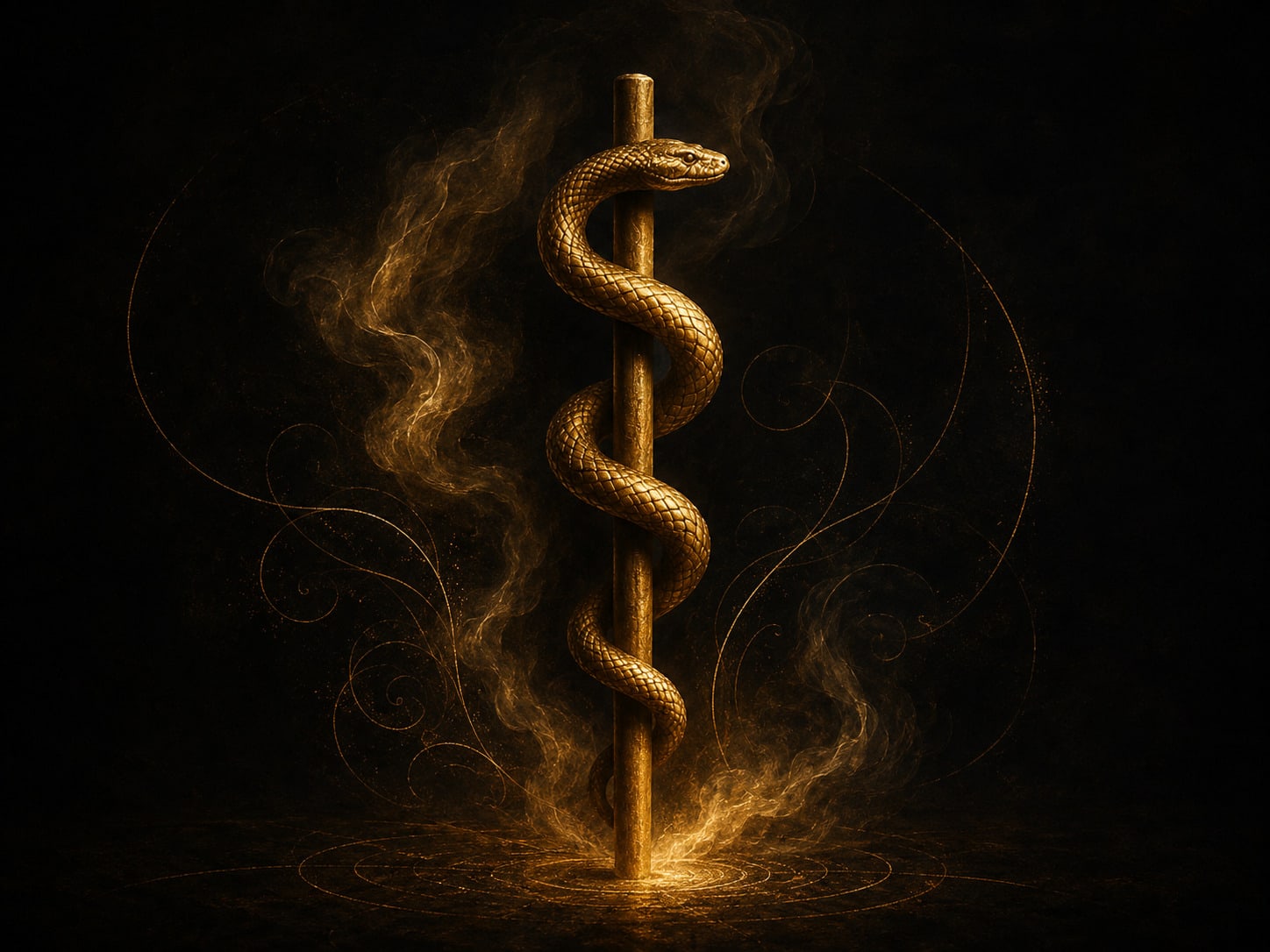
Alongside this interpretive tradition ran the healing sanctuaries of Asclepius, the god of medicine. At sites such as Epidaurus, the sick would purify themselves and then sleep in a sacred hall called the abaton, a ritual known as incubation, hoping the god would appear in a dream to cure them or prescribe a treatment. Asclepius was often imagined arriving as a radiant figure or in the form of a serpent, which is one reason the snake became such a lasting emblem of medicine. Here the dream was not an omen to be read but an event to be experienced, a direct encounter meant to heal. The snake's double life as both healer and threat runs through many traditions, a thread we follow in our guide to what dreams about snakes mean.
05China: two souls and the Duke of Zhou
Classical Chinese thought approached dreams through its understanding of the soul. In one influential model a person has two kinds of soul, the hun and the po. The hun was the lighter, spiritual soul associated with the mind and, in some accounts, with knowing; the po was the heavier, bodily soul tied to memory and the physical self. Several traditional explanations connect dreaming to the movement or activity of these souls during sleep, so a dream could be understood as something the soul did at night rather than a message dropped in from outside.
China also produced its own long-lived interpretive text, the dream book attributed to the Duke of Zhou, a revered early figure whose name became attached to the practice of dream reading much as authority in other cultures gathered around a founding sage. On a more philosophical level, the Daoist thinker Zhuangzi told the famous story of dreaming he was a butterfly and waking unsure whether he was a man who had dreamed he was a butterfly or a butterfly now dreaming he was a man. That parable is not a decoding of a symbol at all; it is a question about the border between dreaming and waking, and it shows that a culture can take dreams seriously as philosophy, not only as prophecy.
06The Dreaming: an Aboriginal Australian framework
Aboriginal Australian traditions are often mentioned in dream articles, and they are also the most frequently misunderstood, so they deserve careful handling. The English words "the Dreaming" and "Dreamtime" translate concepts such as Tjukurpa among the Anangu people and related terms in many other languages. Crucially, the Dreaming is not primarily about the dreams people have while asleep. It is a framework describing the creation of the world by ancestral beings, and the law, relationships, and responsibilities that flow from it, a way of understanding country, kinship, and how to live. Many scholars and community members prefer "the Dreaming" over "Dreamtime" precisely because it is not a bounded past era but a continuous presence that still shapes life.
There are more than two hundred distinct Aboriginal nations, each with its own languages, stories, and law, so there is no single "Aboriginal dream belief" to summarize, and sacred knowledge is often restricted to particular people. The respectful move is to name the specific nation and rely on community-authored sources rather than a colonial-era generalization. The Dreaming belongs in a survey of how cultures relate to dreams, but chiefly as a caution: what looks from the outside like a "dream tradition" is, on its own terms, a whole philosophy of creation and law that the word "dream" only loosely captures.
07Scripture and psychology: three more lenses
Several more traditions each add a distinct reading, and it helps to see them side by side.
In the Jewish and Christian scriptures, dreams are a recurring channel for the divine. Joseph interprets Pharaoh's dreams of seven fat and seven lean cows as years of plenty and famine, and Daniel interprets the dreams of a Babylonian king; Jacob dreams of a ladder reaching to heaven. Later rabbinic discussion in the Talmud weighs how much authority a dream carries, with the well known line that a dream left uninterpreted is like a letter left unread. The texts point in more than one direction, so a careful reader quotes the specific passage rather than claiming scripture assigns any image a single meaning.
Islamic tradition offers one of the most structured frameworks of all. A widely cited teaching sorts dreams into three kinds: the true or good dream understood as coming from God, the distressing dream attributed to Satan, and the ordinary dream that simply reflects a person's own thoughts and daily concerns. The story of Yusuf, the Joseph of the Quran, is the central example of a true dream carrying real meaning. A large later interpretive literature grew up around figures such as Ibn Sirin, and it is best cited as tradition and belief rather than as the Quran itself.
Modern psychology is really just one more cultural lens, our own. Sigmund Freud read dreams as disguised wishes and split them into the remembered story and the hidden feeling beneath it. Carl Jung saw dreams as messages from a deeper layer of the mind and looked for recurring symbols he called archetypes. Neither is settled science, and today's researchers lean more on memory and emotion processing, a shift we cover in our guide to why we dream, and if you want to read Freud and Jung for yourself, the best books on dreams and dream interpretation says where each one still earns its place. Seen honestly, the psychologist decoding a dream at a desk is doing something structurally similar to the temple interpreter, working from a shared set of assumptions their culture handed them.
Hover or tap a row to highlight it.
| Tradition | How it read dreams | A signature example |
|---|---|---|
| Ancient Egypt | Omens catalogued as good or bad outcomes | The Ramesside Dream Book of "if a man sees" entries |
| Mesopotamia | Messages from the gods, read by specialists | Gilgamesh's dreams interpreted by his mother Ninsun |
| Greece and Rome | A system of signs, plus healing sleep | Artemidorus's Oneirocritica and incubation at Asclepius temples |
| China | The soul at night, plus a catalogue of signs | The po soul and the Duke of Zhou dream book |
| Aboriginal Australian | A framework of creation and law, not night dreams | The Dreaming, or Tjukurpa |
| Jewish, Christian, Islamic | Dreams as a channel for the divine | Joseph reading Pharaoh's dream; Yusuf in the Quran |
| Modern psychology | The mind processing wish, memory, and emotion | Freud's disguised wishes; Jung's archetypes |
08The throughline: the same symbols, read differently
Set these traditions next to one another and two things stand out. The first is how universal the seriousness is. From Egyptian scribes to Mesopotamian priests, from Greek healers to Islamic scholars, people across time and place have decided that dreams are worth attention. The second is how much the readings disagree. A snake can be the god of healing in one setting and a hidden enemy in another. A flood can be a divine warning here and an emotion rising there. Water, animals, falling, the dead returning, these images recur everywhere, but their meaning is assigned locally.
That is exactly why no single universal dream dictionary can hold. A dictionary that works has to belong to a particular tradition, and the moment it claims to be the reading for everyone, it has stopped being honest. The useful thing a survey like this can do is loosen the grip of any one system and hand you a better question. Instead of asking what a symbol "means," you can ask which tradition a given reading comes from, whether that tradition is yours, and what the image stirs up in your own life. Read that way, the world's dream traditions become a set of lenses to think with, not a stack of competing verdicts to obey.
09Common questions about dream interpretation across cultures
Are dream symbols universal?
No. Some images recur across many cultures, snakes, water, falling, the dead, but the meaning attached to them is not shared. The same symbol can be lucky in one tradition and threatening in another, which is the clearest sign that dream symbolism is learned rather than fixed.
Which culture has the oldest dream interpretation?
Written dream interpretation survives from several ancient regions, and Egypt's Ramesside Dream Book is among the oldest surviving handbooks, while Mesopotamian dream omens are also very old. But age does not make a system correct or universal. Being early is a fact about history, not proof that one culture cracked a code the others missed.
How do different religions interpret dreams?
Broadly, the Abrahamic scriptures treat some dreams as a way the divine communicates, shown in the dream narratives of Joseph, Daniel, and Yusuf. Islamic tradition adds a clear three-part sorting of dreams into the divine, the distressing, and the ordinary. Hindu, Buddhist, and Chinese approaches vary widely across schools. In every case the responsible move is to cite that tradition's own texts rather than blend them into one.
Can science prove a dream's spiritual meaning?
Science can study dreaming itself, the brain in sleep, why we dream, and how belief works, but it cannot settle whether a dream carries a spiritual message. Those are different kinds of question. A person can hold a spiritual reading as belief while accepting that it is not something a laboratory can confirm.
How should I compare dream traditions respectfully?
Name the tradition you are drawing on, use credited sources from within it, and be especially careful with living traditions and sacred or restricted knowledge. Avoid lifting a specific nation's practice out of context or treating any one culture's reading as the final word. Comparison is healthy; flattening everything into a single dictionary is not.
Reading dreams across cultures
What do nearly all the dream traditions in this guide share?
The ancient Egyptian Ramesside Dream Book mainly sorted dreams into:
The Aboriginal Australian "Dreaming" refers chiefly to:
Pick an answer to begin.
However you came to this question, the most useful step is the same: treat the world's dream traditions as lenses to think with, not verdicts to obey, and read your own dream in your own context. Browse the DreamTold dream dictionary and follow the symbol that stayed with you, remembering that any reading here is reflection and history, not a medical or spiritual diagnosis.
Dream terms
Tap a term to see what it means.
Incubation. The practice of sleeping in a sacred place, common in Egyptian and Greek temples, to receive a healing or guiding dream from a god.
Oneirocritica. The second-century dream manual by Artemidorus of Daldis, the largest surviving dream handbook from the Greek and Roman world.
Hun and po. In classical Chinese thought, two kinds of soul; the po was tied to the body and, in some accounts, linked to dreaming at night.
The Dreaming. The English term for Tjukurpa and related concepts, an Aboriginal Australian framework of creation, law, and country, not a theory of night dreams.
Ru'ya. In Islamic tradition, a true or good dream understood as coming from God, distinguished from the distressing dream and the dream that reflects one's own thoughts.
10Sources
Every claim on this page that comes from somewhere else, with the somewhere else. Scripture and hadith are linked so you can read them in context rather than trusting a paraphrase.
- attalus.org: Artemidorus
- Encyclopaedia Britannica: Jung
- Ibn Sirin dictionary (PDF): Ibn Sirin
- Project Gutenberg: Freud
Related
articles.
Biblical Meaning of Trousers in a Dream (Blessing or Warning)
Dreamed about trousers and wondered if it means something? Here is the biblical meaning of trousers in a dream, straight from scripture, not a symbol chart.
Read: Biblical Meaning of Trousers in a Dream (Blessing or Warning)
Dreams of the Afterlife: Heaven, Passage, and What They Usually Carry
Dreams of an afterlife are common in grief and often bring comfort. What the research can and cannot settle about whether they are a glimpse or a memory.
Read: Dreams of the Afterlife
God Dream Meaning: When You Wake Up Certain
A God dream is remembered for presence more than words. What people describe, how each tradition tests whether a dream is from God, and what is worth doing next.
Read: God Dream Meaning