

Jellyfish Dream Meaning: Harm Without Intent
A jellyfish in a dream usually stands for something that can hurt you without meaning to, and that you cannot read coming. What the sting points to, and what nobody agrees on.
 Featured
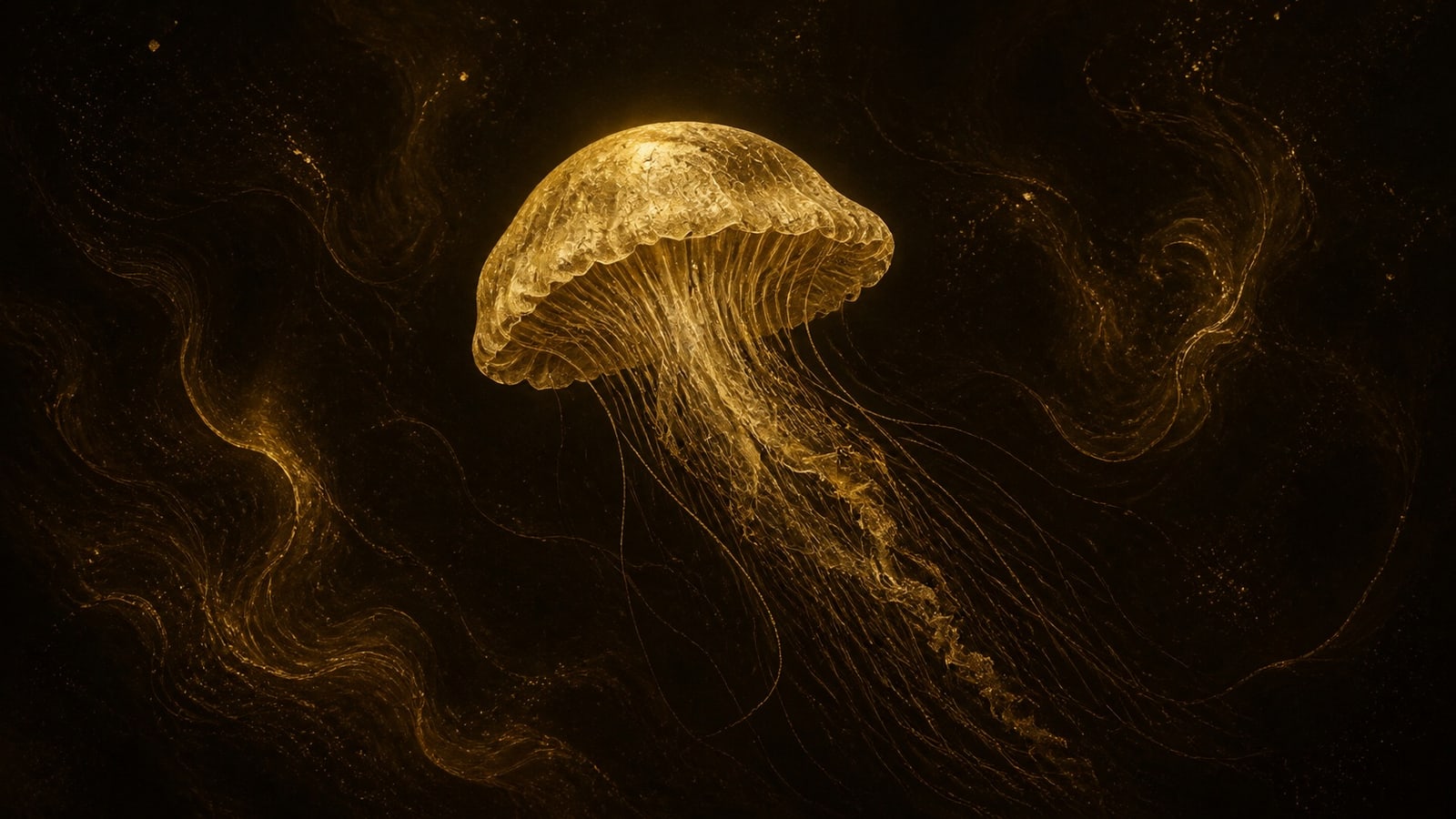
A jellyfish in a dream usually stands for something that can hurt you without meaning to. It is the one threat animal with no intent behind it: it does not hunt, does not choose, and does not know you are there. If you woke unsettled by one, the useful question is usually not who is against you but what you have been drifting near that has a sting you did not see.
Key Takeaways
The short answer
Harm without malice. Something that can hurt you that is not aiming at you.
No face, no intent
A jellyfish has no brain, no eyes to meet, and no way of reading you. That unreadability is the symbol.
The sting is the point
You usually feel it after the contact, not during. That delay is why the image fits situations you only recognize afterward.
Nobody agrees on this one
The ranking pages contradict each other outright. Read that as an open field rather than a hidden consensus.
The traditions are mostly silent
There is no biblical, Quranic, Greek or Hindu jellyfish dream rule. One Japanese folk tale is the real exception.
01It is not aiming at you
Every other frightening animal in a dream has a mind behind it. A bull is coming through. A dog is chasing. A snake is defending itself. Even the mildest of them is oriented toward you in some way.
A jellyfish is not. It drifts. It has no brain in the sense we usually mean, no eyes to meet, and no capacity to decide anything about you at all. If you are stung, it is because you moved into it or it drifted into you. Nothing was chosen.
That is the whole symbol, and it is genuinely different from anything else in this category. A jellyfish stands for harm without malice. It fits the situations in life that hurt without anyone having intended it: a colleague whose manner keeps cutting and who has no idea, a family arrangement that damages everyone and was set up by nobody, a habit or a system or a piece of bad luck that keeps catching you. There is no one to be angry with, which is exactly why those situations are so hard to resolve. You cannot negotiate with something that is not aware of you.
If the dream left you looking for who was responsible and finding no one, that blank is not a gap in the dream. It is the content.
02Why you cannot read it
The second half of the image is about legibility.
We read animals, and other people, from their faces. Where they are looking, whether the body is tense, whether the attention is on us. A jellyfish offers none of that. As one widely shared description of the creature puts it, it "seems almost unreal. No bones. No blood. No voice. No obvious face." It moves like something made of water.
So there is no way to tell whether it is about to matter to you. There is no warning posture, no growl, no eye contact. That maps precisely onto the situations people describe when they have had this dream: something that might be fine, or might not be, and no way to tell from the outside. A relationship in an ambiguous phase. A workplace where you cannot read whether you are in trouble. A person who is perfectly pleasant and about whom you feel uneasy.
That is also why the surrounding water matters so much in this dream. Clear water tends to go with a concern you can at least see; murky water with one you cannot. Water dreams covers the wider pattern, and if the dream was mostly about being submerged rather than about the animal, underwater dreams is closer.
03The sting
For a lot of people this is the specific thing they came to ask about, and it is the part the ranking pages handle worst.
Two features of a real sting do the symbolic work. It happens on contact, without any build-up, and the pain often registers a moment or two after the fact rather than during. You are past it before you know it happened.
That delay is why the image sits so well over situations you only recognize in hindsight. The conversation that seemed fine and that you could not stop thinking about that evening. The decision that felt neutral and turned out to cost something. The remark you laughed at and then found yourself still holding a week later.
The common reading is a boundary, and it is a reasonable one: a sting is what happens where two things touch. If the dream had a sting in it, the question worth asking is where you have recently been closer to something than was good for you, and whether you noticed at the time.
None of this is a warning about anything. A frightening dream can rehearse or reflect a feeling of threat, which is one contested explanation for why threatening dreams happen at all, and the studies testing that idea report mixed results. It is not evidence that a dream sees anything coming.
04What changed the reading
The scene carries more than the animal. These are common readings, offered as reflection prompts rather than fixed meanings.
Hover or tap a row to highlight it.
| The dream | What it often reflects | The emotional read |
|---|---|---|
| Being stung | A boundary crossed, or a hurt you registered late | Shock, then soreness |
| Drifting past one, untouched | Proximity to something risky that did not happen | Relief, unease |
| Surrounded by many | Too many uncertain pressures at once | Overwhelm |
| A giant jellyfish | A concern that has grown out of proportion | Awe, dread |
| A tiny one | Something small that keeps drawing your attention anyway | Irritation |
| Tentacles wrapped around you | Entanglement rather than a single sting | Panic |
| Watching them from behind glass | A concern held at a safe distance, for now | Calm, detachment |
| A glowing jellyfish | Attention drawn to something beautiful and risky at once | Fascination |
| Clear water | A worry you can at least see clearly | Clarity |
| Murky water | Not knowing what you are dealing with | Anxiety |
| A dead or beached one | A threat that feels spent or exposed | Flatness, pity |
| Killing one | Trying to take back some agency | Grim resolve |
| Saving or moving one | Care for something fragile, even something that stung you | Ambivalence |
| One in a pool or the house | A concern that has come close to home | Intrusion |
| Eating one | Taking in something unfamiliar or unpleasant | Disgust |
If you were being pursued rather than drifting, that is a different pattern and being chased in a dream covers it properly.
05The traditions are quieter than the internet is
This is worth stating plainly, because a lot of pages on this search imply otherwise.
There is no jellyfish in the Bible and no biblical jellyfish dream meaning. No passage names the creature, and there is no Christian teaching about dreaming of one. What gets offered instead is usually Genesis 1:20 to 21 on the creation of sea creatures, which is a creation text, or Psalm 69:1 on rising waters, which is David's image for distress. Neither is about a jellyfish and neither is a dream code. A Christian reader may of course use the image to pray about fear or boundaries; that is devotional reflection rather than scripture.
There is no Quranic jellyfish rule either. The Quran's own dream narrative, at Surah Yusuf 12:4, is Yusuf's vision of eleven stars, the sun and the moon. The hadith guidance in Sahih Muslim distinguishes a good vision from a disliked dream and advises seeking refuge in God, and it does not decode any animal. Circulating dream dictionaries attributed to Ibn Sirin need checking source by source, and no verified jellyfish entry was found for this page, so none is quoted.
No ancient Greek, Egyptian, Hindu or Chinese dream manual supplies one. Artemidorus, the main Greek dream manual, has no jellyfish rule. Neither the Hindu textual traditions nor the Chinese Zhougong dream books yield a checked entry. Anyone attributing a jellyfish meaning to those traditions is extrapolating.
The one real exception is Japanese folklore, and it is a good one. In the tale usually titled "Why the Jellyfish Has No Bones", the jellyfish is sent on an errand to fetch a monkey's liver, gives away the plan through its own indiscretion, and is punished by being beaten until it loses its bones. That is a documented folk tale with a specific moral about talking when you should not, and it is the origin of the association between the jellyfish and indiscretion. Note what it is: a story that explains the animal's boneless body, not a rule about dreams. It sits interestingly beside the modern observation that the creature has no bones, no blood, no voice and no face, since the folklore explains that absence as a consequence rather than a design.
That silence is a finding, not a hole. A symbol with no scriptural or classical tradition behind it is a symbol carrying whatever the dreamer brings. On this animal, that is unusually true.
06The other reading, and it deserves a hearing
Everything above leans toward threat, because that is what most people who search this have felt. There is a second reading that is genuinely popular and worth taking seriously.
In contemporary spiritual practice the jellyfish is commonly read as surrender: an animal that does not fight the current, that is carried where the water goes, and that survives by not resisting. The framing usually runs to flow, trust, resilience, and letting go of an effort that is not working. It is the single most common reading on social platforms, well ahead of the threat reading.
It is held as belief rather than established, and it is not in competition with the reading above so much as looking at the same fact from the other side. A jellyfish has no agency in either version. Whether that reads as menace or as peace depends almost entirely on how the dream felt, which is the honest answer to most questions on this page.
Notice which one your dream was. Drifting with them is not the same dream as being stung by one, and people quite often remember the tone before they remember the detail.
07Common questions about jellyfish dreams
What is the spiritual meaning of a jellyfish?
Contemporary spiritual practice tends to read the jellyfish as flow, surrender, sensitivity, or an unnoticed wound, with the sting taken as an image of a boundary or a hurt that went unregistered. These are modern symbolic frameworks held as belief. Older traditions have essentially nothing to say about the animal, which is itself worth knowing before accepting a confident spiritual reading.
What do jellyfish represent in dreams biblically?
Nothing. The creature does not appear in the biblical canon and there is no biblical jellyfish dream meaning. Pages that offer one are usually reaching for Genesis 1:20 to 21 on the creation of sea creatures or Psalm 69:1 on rising waters as an image of distress, neither of which concerns jellyfish or dreams about them.
How do I know if a dream is a warning from God?
This question appears alongside a surprising number of dream searches, which suggests a great many people are carrying it. This page cannot settle a theological question and does not try to. What can be said is that no dream research has shown that any image predicts an event, and that within Islamic guidance the response to a distressing dream is protective prayer and discretion rather than interpretation. Dream omens and warnings covers how warning claims are constructed and where the evidence stops.
What does being stung by a jellyfish in a dream mean?
Most commonly a boundary, or a hurt you only registered afterward. The delay is the useful part of the image: a real sting is often felt a moment after the contact, which fits situations you recognize in hindsight rather than at the time. It is a reflection prompt about proximity, not a prediction that anyone intends you harm.
Does the color of the jellyfish matter?
Folk and personal association attach meanings to blue, pink, white, red and black, and there is no evidence that dream color functions as a code. Given that many jellyfish are naturally translucent, a strongly colored one may simply have been the more memorable image. Your own reaction to it is the more useful signal.
What does it mean to dream of many jellyfish at once?
Usually overload rather than one concern multiplied. People tend to report this version during stretches when several uncertain things are live at the same time and none of them can be settled. Whether you could keep track of where they all were is often the detail that carries the feeling.
Reading your jellyfish dream
What makes a jellyfish different from every other threat animal in a dream?
What does the biblical canon say about jellyfish in dreams?
Which tradition does supply a documented jellyfish story?
Pick an answer to begin.
If a jellyfish has stayed with you since you woke, the question worth sitting with is what you have been drifting close to lately without being able to read it, and whether something has already stung you that you have not fully admitted yet. There may be nobody at fault in it, and that can be the hardest part. DreamTold keeps a fuller dream dictionary if other images from the same night are still with you, and why we dream covers what the sleeping brain is doing while it assembles a scene like this. This page is for reflection rather than diagnosis, it makes no claim about what will happen to you, and if these dreams keep disturbing your sleep please speak to a doctor or a qualified therapist.
Dream terms
Tap a term to see what it means.
Threat simulation. The proposal that some dreams rehearse threatening situations. It is one contested explanation for why frightening dreams occur, and studies testing it report mixed results.
Artemidorus. The author of the Oneirocritica, the main surviving Greek dream manual. It contains no jellyfish rule, which is why claims attributing one to Greek tradition do not hold.
Zhougong dream books. A traditional Chinese dream-interpretation corpus. No checked entry for jellyfish was found, so no reading is attributed to it here.
Ibn Sirin. The name attached to a body of later Islamic dream literature. Circulating editions differ, and no verified jellyfish entry was located.
Continuity hypothesis. The idea that dreams carry on waking concerns. Supported in outline, though the researchers who tested it found the relationship uneven.
08Sources
Every claim on this page that comes from somewhere else, with the somewhere else. Scripture and hadith are linked so you can read them in context rather than trusting a paraphrase.
- attalus.org: Artemidorus
- BibleGateway: Genesis 1:20
- Ibn Sirin dictionary (PDF): attributed to Ibn Sirin
Related
articles.
Owl Dream Meaning: The One That Looks Back at You
An owl dream is usually about attention: being watched, or noticing something you have not said out loud. The scenarios, the traditions, and the death belief.
Read: Owl Dream Meaning
Octopus Dream Meaning: The Grip, and What Has Hold of You
An octopus in a dream usually reflects being held by something with more than one grip on you. What the eight arms stand for, and why most pages get this backwards.
Read: Octopus Dream Meaning
Kitten Dream Meaning: Small Things That Need You
A kitten in a dream usually stands for something small and dependent in your life. Why it is not the same as a cat dream, and what the pregnancy question really is.
Read: Kitten Dream Meaning