

Mermaid Dream Meaning: Human Above, Water Below
A mermaid is split at the waist: the half you can know, and the half you cannot follow. What that points to, the water-spirit readings, and what being one means.
 Featured
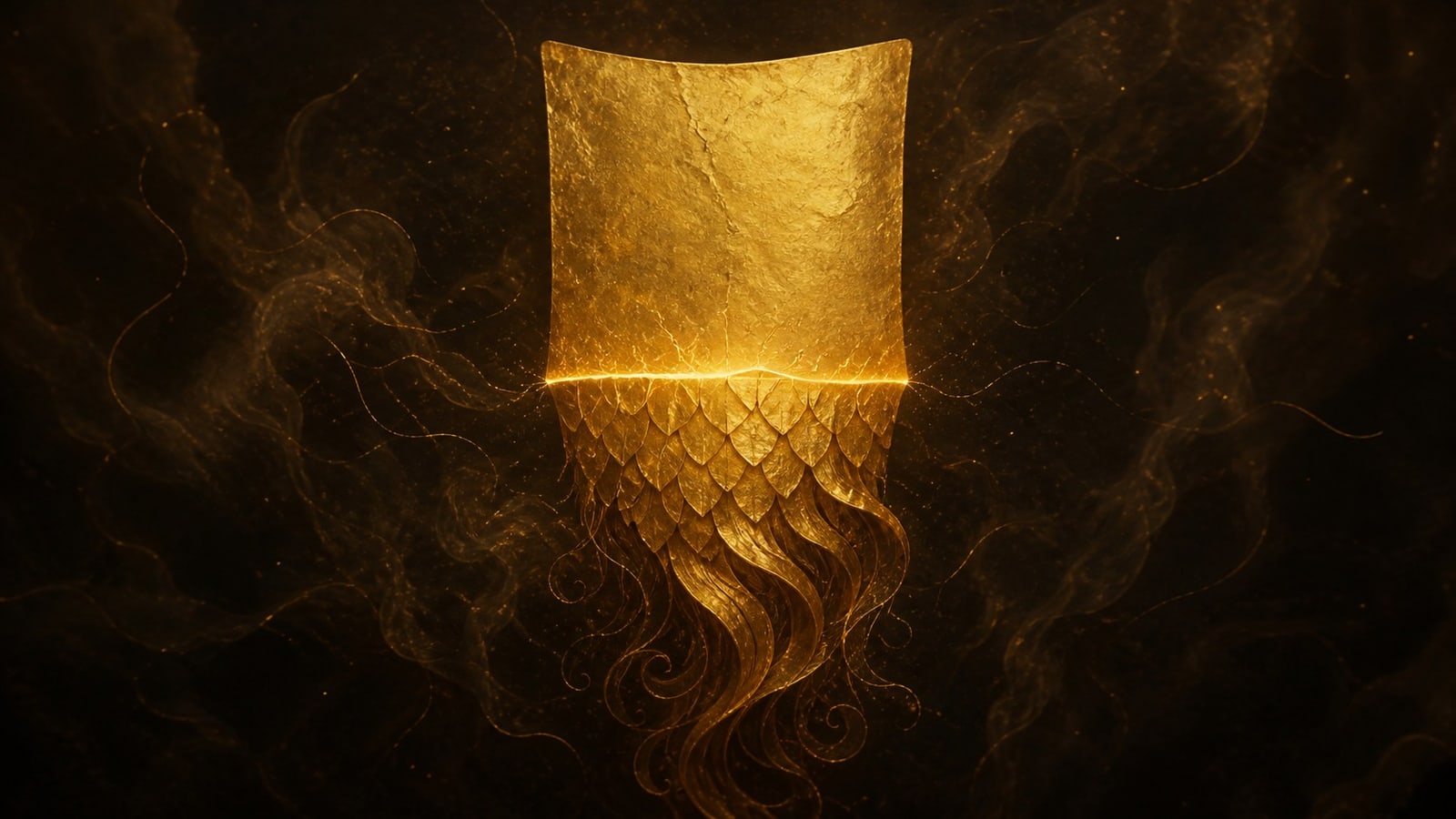
A mermaid is split at the waist, and the split is the whole symbol. Everything above the water is how you know a person: a face, an expression, a voice, sometimes singing. Everything below it is the half that would let her walk over, stand beside you, stay on land, or be ordinary. So the figure is warmth you can see attached to a half you cannot follow, which is why these dreams leave people feeling something they struggle to name. If you came here frightened by something you read about marine spirits, that is addressed properly further down.
Key Takeaways
The short answer
Something or someone half available. Reachable above the water, not below it.
The split is not arbitrary
The human half is the part you can know. The other half is the part that cannot come ashore.
Being the mermaid
Extremely common, and usually about a part of yourself that does not come out on land.
Where she lives
At the edge, in form and in place. That in-between is the point rather than a detail.
On marine spirits
A sincerely held reading in specific named traditions. A dream is not evidence that anything has attached itself to you.
01The split is at the waist
Think about what the mermaid is made of, because it is oddly precise.
The upper half is every part we use to recognize a person: the face that shows feeling, the eyes, the voice, the hands. It is the half that can talk to you, look at you, and want something. The lower half is the half that decides where a body can go. Legs are how a person walks toward you, stands next to you, follows you home, or stays. A tail is a beautiful, useless thing on land.
So the figure is not simply half-fish. It is half-known and half-unreachable, and the seam runs exactly between the part that can love you and the part that could stay. People often describe the dream as tender and slightly sad, and that combination is not a contradiction. It is the shape of the symbol.
The other half of it is where she is found. The Library of Congress's folklife writing on mermaids describes her as liminal twice over: mixed in form, and located at the edge where the sea meets the shore. She belongs to the boundary rather than to either side of it, which is why the same figure can read as inviting and as ominous without changing anything about her.
02Who was half available?
That is the useful question, and it usually produces an answer quickly.
A person. Somebody warm, attentive, and structurally unavailable: married, leaving, unwell, addicted, emotionally present and practically absent, or simply somebody who will not come further. The dream is not accusing them of anything. It is describing the geometry.
An offer or a situation. Something lovely above the waterline whose real terms are underneath and not visible. A job, an opportunity, a move. If the dream carried unease alongside the beauty, that unease is the content, and it deserves more respect than the beauty does.
Yourself. This is the version people search most, and it is the least well served. If you dreamed you were the mermaid, the question is which part of you does not come ashore. Many people can name it at once: the part that is only itself in private, the version of them that never shows up at work, the self that existed before a role took over. Dreaming of a tail is often a dream about not being able to walk into a room as who you actually are.
The old stories keep noticing the cost of the crossing. In the folklore that reaches us, becoming human is rarely free, and going back is rarely possible.

03What she did, and what the water was like
The water matters here more than in most dreams, because half the figure is in it.
Hover or tap a row to highlight it.
| The dream | What it often reflects | The emotional read |
|---|---|---|
| A mermaid watching from the water | Something present and not approaching | Curiosity |
| A friendly or helpful mermaid | Connection with something you cannot keep | Warmth |
| A mermaid singing | Being called by something you know you should not follow | Pull |
| A mermaid luring you under | An attraction with terms you can feel and not see | Unease |
| Being pulled down | Overwhelm, or a relationship that costs you air | Panic |
| An aggressive mermaid | Fear of the attractive thing, rather than of a creature | Dread |
| Clear water | You can see what you are dealing with | Calm |
| Dark or deep water | You cannot, and you know it | Apprehension |
| Being a mermaid | A part of you that does not come out on land | Recognition |
| Becoming a mermaid | Adapting to survive somewhere you were not made for | Ambivalence |
| Losing your tail, or growing legs | A change of state, wanted or not, and what it costs | Vertigo |
| Rescuing a mermaid | Caring for someone who cannot stay | Tenderness |
| A stranded mermaid | Something alive that is in the wrong element | Pity |
| A mermaid and a mirror | Self-image, and what you show above the surface | Exposure |
| A mermaid speaking your name | Being individually recognized by something unknown | Awe |
04The water-spirit traditions, named properly
This is the part of the subject that has real weight for a lot of readers, and it is handled badly nearly everywhere.
Across West African and diaspora traditions, water spirits are a serious religious category rather than a fairy tale, with Mami Wata the most widely known figure. In Yoruba tradition Oshun is the orisha of the river. In parts of Southern Africa, dreams of water and of a figure in it can be read as an ancestral calling, an indication that somebody is being summoned to train as a healer, and the vocabulary for that is specific in isiZulu rather than generic. These are not the same tradition and they should not be melted into one.
Alongside them, in some deliverance-focused Christian teaching, particularly in West Africa and its diaspora, a mermaid in a dream is read as a marine spirit: an entity understood to be attaching itself to a person, tied to seduction, deception, blocked progress, or spiritual attack. That reading is prominent enough that Google's own results extract it, and it is stated plainly in a video from July 2026: mermaids as connected to marine spirits and to spiritual forces operating in the water realms, drawing a person away from their purpose.
Two things are true at once here, and the page will not choose between them for you. These are sincerely held beliefs within living traditions, held by people who have thought about them far longer than any dream page has. And a dream is not evidence that something has attached itself to you. Whatever you believe about spirits, a night's imagery is not a diagnosis of your spiritual condition, and no one on the internet, including this site, can examine your soul from a dream description. If the dream frightened you, the people worth speaking to are the ones inside your own tradition who know you.
05What the other traditions hold
There is no mermaid in the Bible, and no passage assigns a meaning to dreaming of one. What scripture has is sea imagery, and it runs to the sea's power rather than to its inhabitants: sailors overwhelmed by a storm and brought to a calm haven in Psalm 107:23-30, Jonah's storm and the great fish, and Leviathan in Isaiah 27:1 as an image of chaos overcome. The beast from the sea in Revelation 13:1 is an apocalyptic political image. The four passages are here. Those are worth knowing precisely, because they are what is actually there.
The Quran contains no mermaid-dream interpretation either, and there is a further point worth making because you will meet a lot of confident writing to the contrary: no verifiable early entry for a mermaid or sea woman can be traced in the dream material attributed to Ibn Sirin. The readings circulating under that name online cannot be sourced. What Islamic teaching does supply is the classification of dreams into good tidings, distressing dreams that are not from God, and the ordinary thoughts of one's own mind, reported in Sahih Muslim 2263a.
In Greek tradition, the Sirens of the Odyssey are not mermaids. In Homer's twelfth book they are dangerous singers whose voices draw sailors onto the rocks, and they are not described there as fish-tailed. The fish-bodied figure people are usually thinking of appears elsewhere, including Diodorus Siculus's account of Derceto at Ascalon, a woman's face on an otherwise fish body. The singing and the tail arrived from different places and got joined later.
Japanese folklore gives the ningyo, literally human-fish, and the best-known tale is Yaobikuni, the girl who ate its flesh and lived eight hundred years as a Buddhist nun. A very long life, spent outliving everyone. And Hindu tradition has Matsya, the fish avatar of Vishnu, who warns Manu of the coming flood and preserves life through it, a rescue narrative rather than a lure.
06Common questions about mermaid dreams
What is the spiritual meaning of a mermaid?
Contemporary spiritual practice reads her as intuition, emotional depth, creative flow, and transformation between one state and another, with a friendly mermaid taken as permission to listen inward and a luring one as a caution about porous boundaries. In several named traditions the readings are far more specific, from ancestral calling to the marine-spirit teaching described above. All of it is belief, and the traditions differ from each other rather than forming one system.
What does it mean to dream of being a mermaid?
Usually that some part of you does not come out on land. People often identify it immediately once the question is put that way: the self that only appears in private, the version that predates a role, the part that would not survive the office. It can also carry a gentler reading about adapting to an environment you were not built for and becoming good at it, which has its own cost and its own pride.
Was the mermaid warning me?
Folklore and several religious traditions do read her that way, and the singing-and-luring image is old enough that the caution is embedded in the figure. There is no evidence that dreams report on future events. What the dream is likely reporting on is present unease about something attractive, and that unease is worth taking seriously on its own terms rather than as a forecast.
What does it mean if the mermaid was frightening or attacked me?
Take the fear as the content. An attractive figure that turns dangerous is a compact image for a situation you are drawn to and do not trust, and readers can usually name the situation faster than they expect. If the dream was a nightmare that has recurred, that is a different matter and worth reading about in what nightmares are.
Does dreaming of a mermaid mean I am pregnant?
No, and no dream image indicates a pregnancy. Water dreams do turn up in some people's accounts around pregnancy, and dream content follows what preoccupies a person, so somebody hoping for or worrying about a pregnancy may well dream about water. That is the direction the influence runs. A test tells you about a pregnancy; a dream tells you what is on your mind.
Why do I keep dreaming about mermaids?
Recurrence usually points at something unresolved rather than escalating: a person who is still half available, a part of yourself still waiting to come ashore, or a decision you keep approaching and not making. Recurring dreams covers the pattern. If the dreams distress you or disturb your sleep, that is worth raising with a doctor or a therapist.
Reading your mermaid dream
Why does the split at the waist matter?
In Homer's Odyssey, what are the Sirens?
What can a mermaid dream tell you about your spiritual condition?
Pick an answer to begin.
If a mermaid has stayed with you since you woke, the question worth sitting with is who or what has been half available lately, and whether the half you cannot reach is somebody else's or your own. That is usually a more uncomfortable question than the folklore, and considerably more useful. DreamTold keeps a fuller dream dictionary if other images from the same night are still with you, and why we dream covers what the sleeping brain is doing while it builds a figure out of two halves. This page is for reflection rather than diagnosis, it makes no claim about anybody's spiritual condition, and if these dreams keep disturbing your sleep please speak to a doctor or a qualified therapist.
Dream terms
Tap a term to see what it means.
Liminal. Belonging to a threshold rather than to either side of it. The Library of Congress describes the mermaid as liminal twice over, in her form and in where she is found.
Ningyo. Literally human-fish, the Japanese folklore creature. In the Yaobikuni tale, eating its flesh gives eight hundred years of life.
Derceto. The fish-bodied goddess of Ascalon described by Diodorus Siculus, and a closer ancestor of the modern mermaid than the Sirens are.
Matsya. The fish avatar of Vishnu, who warns Manu of the flood and preserves life through it. A rescuer rather than a lure.
Continuity hypothesis. The idea that dreams carry waking concerns into sleep. Better supported for emotion than for specific images.
07Sources
Every claim on this page that comes from somewhere else, with the somewhere else. Scripture and hadith are linked so you can read them in context rather than trusting a paraphrase.
- BibleGateway: The four passages are here
- Encyclopaedia Britannica: Matsya
- Library of Congress: folklife writing on mermaids
- penelope.uchicago.edu: Diodorus Siculus's account of Derceto at Ascalon
- Sunnah.com: Sahih Muslim 2263a
- The British Museum: ningyo
- Theoi Project: Homer's twelfth book
- YouTube: it is stated plainly in a video from July 2026
Related
articles.

Snake in Water Dream Meaning: A Feeling You Cannot See the Bottom Of
What a snake in water dream means, read by the water's clarity and the snake's path, plus biblical, Islamic, and Hindu readings. A grounded, no-omens guide.
Read: Snake in Water Dream Meaning
Drinking Water in a Dream: Clear, Dirty, and Never Enough
Still thirsty after drinking water in a dream? Here is the physical explanation, the psychological read, and what several traditions believe it means.
Read: Drinking Water in a Dream
Black and White Striped Snake Dream Meaning: Duality Explained
Black and white striped snake dream meaning: a black and white choice, a camouflaged warning, and what several traditions each say it means.
Read: Black and White Striped Snake Dream Meaning