

Teeth Falling Out One by One in a Dream: Meaning
Dreaming your teeth fall out one by one usually reflects slow, drip-by-drip stress or a gradual sense of losing control, not a death omen. Read yours here.
 Featured
Dreaming that your teeth fall out one at a time usually reflects a slow, drip-by-drip stress or a gradual sense that control is slipping, rather than the single shock of every tooth going at once. It is not reliable evidence of a death, an illness, or that each tooth stands for a person, and the pace itself is often the most telling part.
Key Takeaways
Slow, not sudden
Losing teeth one by one tends to mirror a wearing, gradual stress rather than one dramatic loss.
A control theme
The steady pace often reads as a sense that you are losing your grip a little at a time.
Not a death omen
There is no reliable evidence a teeth dream forecasts death or the loss of a relative.
No fixed tooth code
The old idea that each tooth names a specific person is folklore, not a rule.
A body layer is possible
Jaw clenching or grinding may nudge the imagery for some sleepers, so a physical symptom is its own reason to see a dentist.
Reflection, not diagnosis
Read the dream as a prompt to check in with your life, not a medical or spiritual verdict.
01The most common meaning
The general theme of teeth falling out tends to track a cluster of connected feelings: anxiety, vulnerability, worry about how you are seen, and a fear of losing control. What the one-by-one version adds is pace. When the teeth go individually, one and then another and then another, the dream is not staging a single catastrophe. It is staging a slow leak. That drawn-out rhythm is why this variant so often surfaces during a stretch of life that wears on you gradually rather than arriving all at once.
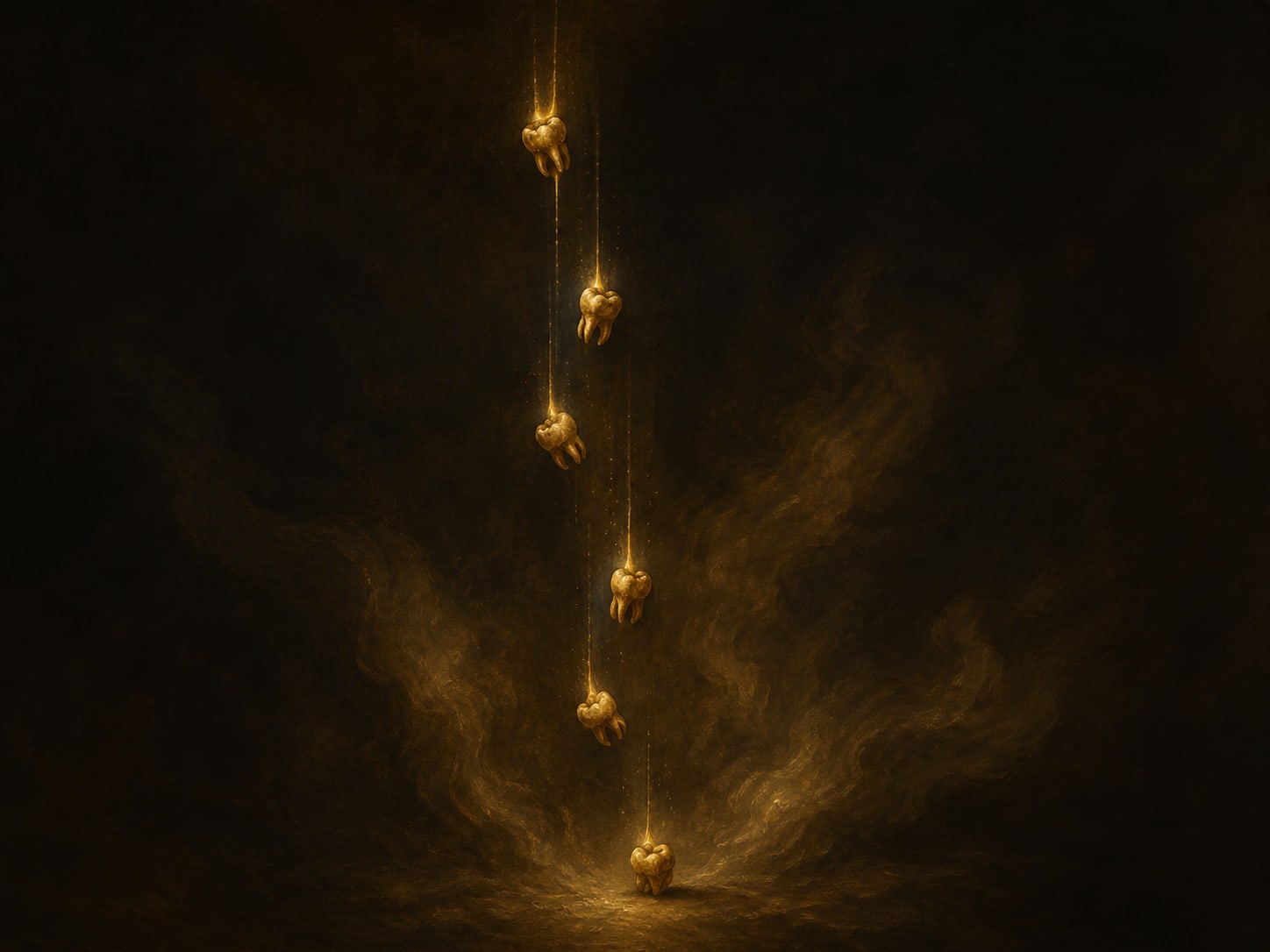
Think of the difference between a wall collapsing and a wall losing one brick a week. Both end in a loss, but they feel nothing alike. A drip-by-drip teeth dream usually belongs to the second kind of experience: a long project that keeps taking more than it gives, a relationship cooling by degrees, savings or energy or confidence draining a little at a time, or a role you are quietly aging out of. The mind reaches for a physical image that matches the tempo of the feeling, and teeth leaving the mouth one by one fits a slow erosion better than almost anything.
It helps to say plainly that no single meaning fits everyone, because teeth dreams tempt people toward tidy, one-line answers. The most reliable clue is not the tooth at all. It is the emotion you woke with, and whatever in your current life carries that same steady, wearing quality. For the wider symbol this variant belongs to, our full reading of teeth falling out in a dream covers the theme as a whole; this piece stays with the one-at-a-time pace.
02Why the one-by-one pace matters
The sequence is worth taking seriously as its own signal rather than treating it as background detail. A dream is emotional and associative, and during vivid sleep the brain tends to build a scene that carries a feeling rather than a message written in code. If the feeling in question is gradual, a gradual scene is a natural match. That is the simplest reading of the one-by-one image: the pace of the dream mirrors the pace of the pressure.
Several psychological lenses line up with that, and each is worth holding as a frame rather than a proven law. In the psychoanalytic tradition, thinkers from Freud onward tied teeth loss to anxiety, aging, and a sense of powerlessness, and later interpreters added loss of control and fear of change. Read through that lens, teeth departing one at a time can echo a control you feel ebbing in small, repeated increments rather than in a single blow. None of these are settled mechanisms, and modern dream researchers lean more on emotion processing than on hidden symbols, but the common thread is useful: the drip-by-drip image usually describes a relationship between you and a slow strain, not an outside event bearing down.
There is also the honest question of how common this all is, which matters because it takes some of the fear out. In a 2018 study published in Frontiers in Psychology, roughly 39 percent of participants reported having experienced a dream about teeth, and around 16 percent said the theme recurred. A recurring, one-by-one teeth dream, then, is one of the most reported dream experiences worldwide. If yours felt intensely personal, that is normal; it does not single you out. If you want to understand why a waking worry turns into such a physical picture in the first place, our grounded look at why we dream covers what the research actually supports.
03The mouth-and-sleep layer
Alongside the emotional reading there is a physical hypothesis worth naming honestly, because it is the part people most often overlook. Researchers have looked at whether sensations from the mouth and jaw during sleep get folded into dream content, a process sometimes called incorporation. Bruxism, the grinding or clenching of the teeth during sleep, is the usual suspect. The same 2018 study found teeth dreams were associated more with dental irritation on waking, tension in the teeth, gums, or jaw, than with general psychological distress, which suggests that for some sleepers the origin may be physical rather than symbolic.
That is intriguing rather than conclusive, and it applies to some people more than others, so it is best held as one reasonable explanation among several. It fits the one-by-one pattern in a plausible way: a night of intermittent clenching is itself a stop-start, repeated sensation, and the mind may translate that halting physical signal into teeth leaving in a halting sequence. This is a hypothesis, not a proven rule, and it does not mean the dream is meaningless. It means the picture may be drawing on a real bodily sensation as well as a feeling.
The practical takeaway is simple and separate from any interpretation. If you wake with jaw tension, tooth pain, sensitivity, or a partner tells you that you grind, treat that as its own reason to see a dentist. That is a physical symptom worth addressing on its own terms. The dream is a reflection, not a dental diagnosis, and no interpretation of it should stand in for a checkup when something in your mouth genuinely hurts.
04How the scene changes the meaning
The same one-by-one loss can read quite differently depending on what accompanies it: blood or none, calm or panic, in private or in front of people. Use the whole scene rather than the bare fact that teeth fell. The grid below is a starting point for reflection, not a verdict, and the strongest emotion you felt matters more than any single row.
Hover or tap a row to highlight it.
| The scene | What it often reflects | The emotional read |
|---|---|---|
| Teeth dropping one at a time, calmly | A slow loss you have half accepted | Wearied, resigned to a gradual change |
| One tooth every few moments, no end in sight | A drain that keeps returning | Ongoing, grinding stress |
| Falling out one by one with blood | A slow loss that also feels raw or costly | Gradual change that still stings |
| Front teeth going first, one by one | Appearance, speech, being seen | Self-image eroding a little at a time |
| Molars or back teeth loosening slowly | Private strength or foundations wearing thin | Quietly unsteady, less visibly |
| Pulling them yourself, one by one | A change you are enacting in stages | Taking hard action piece by piece |
| Losing them one by one in public | Fear of visible, ongoing embarrassment | Exposed while you are still coping |
Notice that the pace holds across every row. Even the versions that add blood or an audience are describing a loss that unfolds rather than one that detonates, and that is the through-line to trust. If your dream tipped from unsettling into genuinely distressing, our guide to what nightmares mean puts that experience in context and covers when disrupted sleep is worth raising with a professional.
05Spiritual and cultural meaning
Spiritual and cultural readings of teeth loss are among the most searched parts of this topic, and the honest starting point is that teeth carry no fixed scriptural meaning. There is no single passage that assigns them one symbol, and biblical readings in particular vary from passage to passage and from teacher to teacher, so anyone presenting a definitive verse should be treated with caution. These traditions are best held as belief and as prompts for reflection, never as fact or prediction.
The most persistent belief attached to this dream is the folk idea that a falling tooth foretells the death or illness of a relative, and it is worth being straight about how old and how widespread that superstition genuinely is. It appears in the Jewish Talmud, in dream books traceable to ancient Egypt, in the second-century Greek writer Artemidorus, and in later Islamic interpretive works associated with Ibn Sirin, some of which went further and tried to name which relative based on which tooth was lost. That long lineage is exactly why the belief feels so weighty when it surfaces. But its age is not evidence that it is accurate. It is documented folklore, a cultural inheritance to reflect on, not a forecast, and there is no reliable evidence that a teeth dream predicts anyone's death. The idea that a slow, one-by-one loss means relatives will be taken one at a time is an especially heavy reading to place on a dream, and it is not supported.
Other traditions bend the same image toward something gentler. Some fold teeth into the theme of shedding and renewal, closer to how a child loses baby teeth before adult ones grow in, so a slow loss can read as an old chapter making room for a new one. Various folk beliefs tie teeth to speech and reputation, linking the dream to gossip or words spoken about you. Set beside the physical layer above, the calmer traditions and the stress-and-grinding angle can coexist: a dream can be a nudge to reflect and, at the same time, a picture partly built from a clenched jaw. Whatever framing speaks to you, treat a one-by-one teeth dream as an invitation to reflect within your own beliefs, held lightly, rather than as an alarm about a specific person or a coming event.
06Key scenarios and variants
The one-by-one loss shows up in a handful of recognizable versions, and each bends the same slow theme in its own direction. Read your scene for its feeling first, then use these as prompts.

- Teeth dropping one at a time with no pain often emphasizes acceptance over injury, a change you have quietly resigned yourself to rather than one you are fighting.
- One tooth loosening every few moments, on and on, tends to mirror a stress that keeps resurfacing, the kind that never fully resolves and never fully explodes either.
- Front teeth going first, one by one, connects most directly to appearance and speech, and often surfaces around self-image or a fear of being judged over time.
- Losing them one by one with blood adds a raw, costly edge to the slow loss, marking a gradual change that still hurts as it happens.
- Pulling your own teeth one at a time points to a hard change you are enacting in stages, letting go of something deliberately even though each step is uncomfortable.
- Losing them one by one in public tends to echo a fear of visible, ongoing embarrassment, coping in the open while the change keeps unfolding.
If a one-by-one teeth dream keeps returning as a distressing nightmare, that repetition is worth noticing, less as an outside message and more as a sign of something unresolved. It sits among the most common dreams and what they mean, and the teeth falling out entry in the dream dictionary collects the wider symbolism in one place.
07Common questions about teeth falling out one by one
Why do my teeth fall out one by one instead of all at once?
The one-by-one pace usually mirrors a slow, wearing stress rather than a single shock. A dream tends to match the tempo of the feeling behind it, so a gradual strain in waking life often shows up as a gradual loss in the dream. It is best read as the mind picturing a slow drain, not as a coded sequence.
Does each tooth represent a person in my life?
No universal evidence supports that. The idea comes from old dream books that tried to map specific teeth to specific relatives, but it is folklore, not a reliable rule. Read the dream for its overall feeling and pace, not as a roster of named people.
Does a one-by-one teeth dream mean death is coming?
No. The belief that a falling tooth foretells a death is ancient and widespread, but its age is not proof, and there is no dependable evidence linking teeth dreams to death or illness. Reading it literally tends to add fear without adding insight.
Could grinding my teeth cause this dream?
For some sleepers, yes as a hypothesis. One study linked teeth dreams more to dental irritation on waking than to psychological distress, and a stop-start night of clenching may feed a stop-start dream. It is not a proven rule for everyone. If you have jaw tension, pain, or sensitivity, see a dentist about the symptom regardless of the dream.
What if the teeth fall out one by one with no pain?
A painless, gradual loss often shifts the read from injury toward acceptance. The dream may be reflecting a change you have quietly made peace with, or a slow drain you have stopped resisting, rather than acute fear. The calm is part of the message.
Why do I keep having this dream over and over?
Recurring teeth dreams usually track an ongoing stress rather than a message repeating until you decode it. Around 16 percent of people who have teeth dreams report them recurring, so the pattern is common. The theme tends to ease once the underlying worry is named and addressed, and treating any grinding with a dentist may reduce how often the image appears.
Reading your one-by-one teeth dream
Losing teeth one at a time in a dream most often reflects what?
The old belief that a falling tooth foretells a relative's death is best understood as:
If you wake from a teeth dream with jaw tension or tooth pain, the sensible step is to:
Pick an answer to begin.
Whatever brought you here, the next step is the same: read the one-by-one loss in your own context, and start with the slow, wearing feeling it left rather than any omen attached to it. Look up the teeth falling out entry in the dream dictionary at DreamTold, and if a symptom in your mouth is bothering you, treat that as its own separate reason to check in with a dentist.
Dream terms
Tap a term to see what it means.
Bruxism. Grinding or clenching the teeth, often during sleep, which can cause jaw tension or tooth wear and is one hypothesized link to teeth dreams.
Incorporation. The process by which a real physical sensation during sleep, such as a clenched jaw, gets folded into the content of a dream.
Manifest content. The literal story of a dream, the images and events you actually remember, such as teeth dropping one by one.
Latent content. The deeper feeling a dream image stands in for, such as the slow stress or loss of control the sequence gives shape to.
Anxiety dream. A dream driven by worry or tension that surfaces a waking-life stress rather than predicting any event.
08Sources
Every claim on this page that comes from somewhere else, with the somewhere else. Scripture and hadith are linked so you can read them in context rather than trusting a paraphrase.
- attalus.org: Artemidorus
- Ibn Sirin dictionary (PDF): Ibn Sirin
- Project Gutenberg: Freud
- PubMed: 2018 study
Related
articles.
Loose Tooth Dream Meaning
A loose tooth dream meaning depends on what happened next: the tooth stuck, pulled, or finally out. See what psychology and tradition each say about it.
Read: Loose Tooth Dream Meaning
Front Teeth Falling Out Dream Meaning: Appearance, Reputation, and Being Seen
Dreaming your front teeth fall out often points to appearance, reputation, and how you are seen, not a real loss coming. Read what your dream may mean here.
Read: Front Teeth Falling Out Dream Meaning
Pulling Out Your Own Teeth Dream Meaning: Control and Self-Driven Change
Dreaming you pull out your own teeth usually points to control and self-driven change: forcing an ending or removing what hurts. It is not a curse or omen.
Read: Pulling Out Your Own Teeth Dream Meaning