

What Does Islam Say About Dreams?
What Islam teaches about dreams: the three kinds described in the Quran and hadith, the etiquette after a good or bad dream, and the limits of meaning.
 Featured
Islamic tradition commonly describes three kinds of dreams: a true or good dream understood as glad tidings from Allah, a distressing dream associated with shaytan, and a dream that simply reflects a person's own thoughts. A good dream may be received with gratitude, while hadith guidance advises seeking refuge with Allah after a disturbing dream and not treating it as a harmful prediction. Specific interpretation is never automatic, and it should not override the Quran, the Sunnah, sound judgment, or qualified guidance.
Key Takeaways
Three kinds
Tradition distinguishes a true dream from Allah, a distressing dream linked to shaytan, and a dream from one's own mind.
Received, not decoded
A good dream is met with gratitude; a bad one is met with seeking refuge, not fear.
The Quran shows dreams
Surah Yusuf and the account of Ibrahim treat certain prophetic dreams as revelation.
Ibn Sirin is later tradition
The interpretive works tied to his name are influential, but they are not the Quran or a binding code.
Meaning has limits
A dream cannot establish a religious ruling, foretell the unseen, or justify accusing anyone.
Seek local guidance
For a troubling personal dream, a qualified local scholar or imam is the right place to ask.
01The three kinds of dreams in Islamic teaching
The most widely cited framework comes from a saying reported from the Prophet Muhammad. In Sahih Muslim (2263), dreams are described as being of three types: glad tidings from Allah, what is on a person's mind, and a frightening dream from shaytan. A closely related report in Sahih al-Bukhari (6995) states plainly that a good dream is from Allah and a bad dream is from Satan. These reports are the backbone of how Muslims commonly talk about dreams, and they are best understood as prophetic guidance rather than as a decoding manual.
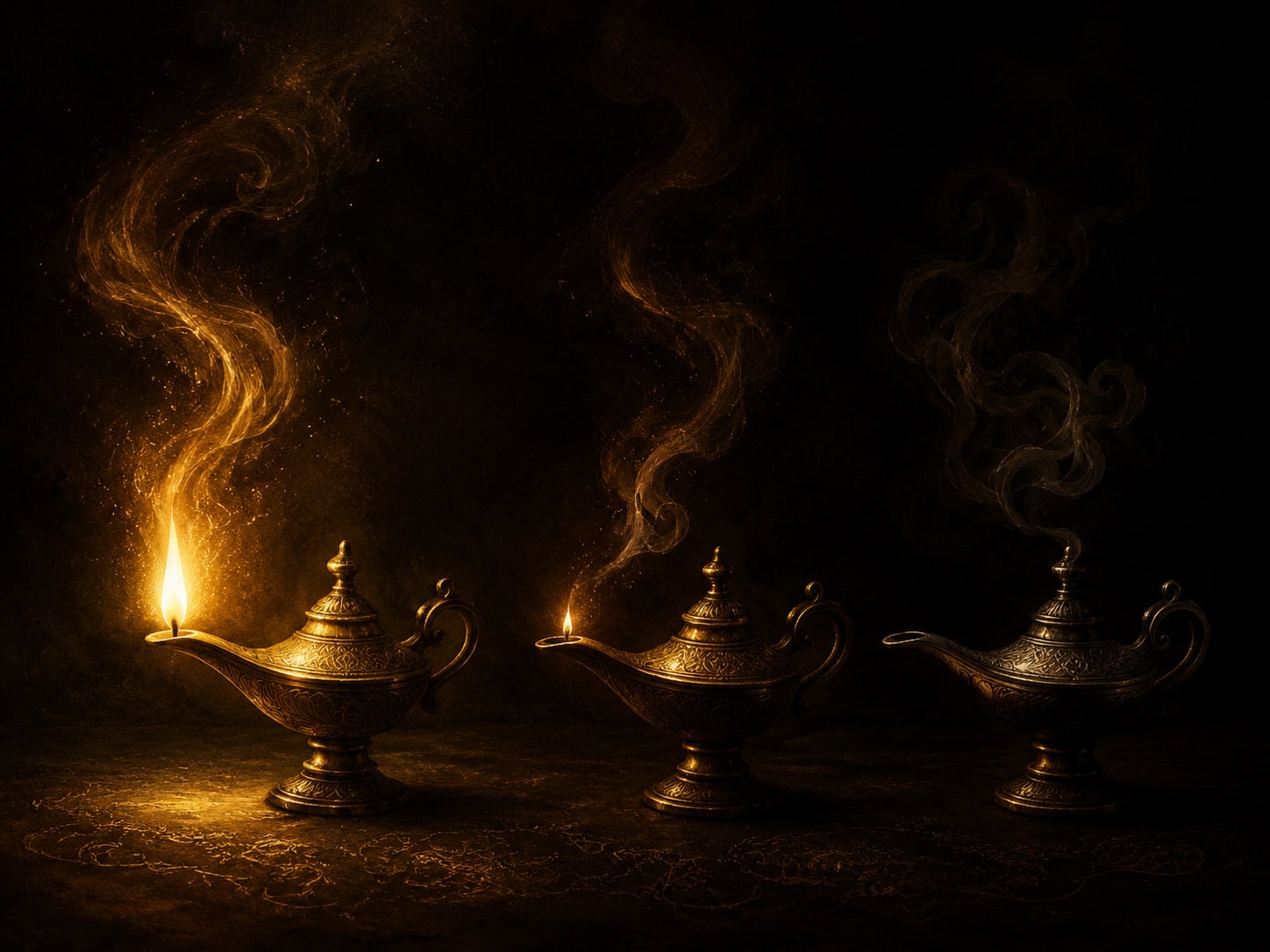
The three categories do different work. A true or good dream, often called a ru'ya, is treated as a form of good tidings, and one hadith in Bukhari (6983) goes further, calling a righteous person's good dream one of forty-six parts of prophethood. That is a striking phrase, and it is worth reading carefully: it honors the good dream without turning every sleeping image into a message. A distressing dream, sometimes called a hulm, is associated in these reports with shaytan and is meant to unsettle. The third kind is the most ordinary of all, simply the mind turning over the day's worries and wishes, what tradition connects to the nafs, the self. Much of what any of us dreams falls into that last, everyday category rather than the first.
Because the categories overlap with how anyone experiences sleep, they map neatly onto the wider picture of why the sleeping mind produces vivid scenes at all. Islamic teaching does not deny that ordinary thoughts shape dreams; it names that as one of the three sources. If you want the general science of how and why the brain dreams, our guide to why we dream covers REM sleep and the leading theories, which sit comfortably beside the tradition's idea that many dreams are simply the self at work.
Hover or tap a row to highlight it.
| Kind of dream | Source in tradition | How a Muslim is traditionally advised to respond |
|---|---|---|
| A true or good dream (ru'ya) | Glad tidings from Allah | Receive it with gratitude and praise; share it only with those who wish you well |
| A distressing dream (hulm) | Associated with shaytan | Seek refuge with Allah, do not dwell on it, and do not spread it |
| A dream from one's own thoughts | The person's own mind and nafs | Treat it as ordinary; no special action is called for |
02Dreams in the Quran
The Quran itself contains several dream narratives, and they are where Islamic teaching about meaningful dreams is rooted most firmly. The fullest is the story of the Prophet Yusuf, known in the Bible as Joseph, told across Surah Yusuf, the twelfth chapter. Early in the surah (12:4), the young Yusuf tells his father that he saw eleven stars, the sun, and the moon prostrating to him. That vision sets the whole narrative in motion, and near the end of the surah (12:100) Yusuf reflects that his Lord has made the dream come true. Within the story, the dream is treated as true and as revelation given to a prophet, not as a puzzle any dreamer could have solved alone.
Surah Yusuf also includes the dreams of others: the two prison companions and the ruler of Egypt, whose vision of seven fat and seven lean cattle Yusuf interprets. Muslim scholars often note that even here the ability to interpret is described as a gift from Allah rather than a technique. A second major account appears in Surah as-Saffat (37:102), where the Prophet Ibrahim, Abraham, tells his son that he has seen in a dream that he is to sacrifice him, and the son answers with submission. In classical understanding the dreams of prophets are a category of their own, treated as a form of true guidance. That is an important boundary: the Quran's dream narratives concern prophets and revelation, and tradition is careful not to extend that status to everyone's sleep.
03The etiquette after a good or a bad dream
Beyond categories, the hadith give practical etiquette, and this is often the part a worried reader most wants. For a good dream, the guidance is gentle: be grateful, praise Allah, and, if you wish, share it with people who care for you. One report in Bukhari and Muslim, narrated from Abu Qatada, frames the good dream as coming from Allah and encourages telling it only to those one loves.
For a distressing dream the same tradition gives a clear, calming set of steps rather than an interpretation. The Abu Qatada report advises a person who sees something they dislike to seek refuge with Allah from shaytan, to spit dryly three times to the left, to change the side they were lying on, and, in a related narration in Sahih Muslim (42), to get up and pray. Crucially, the guidance says not to mention the bad dream to anyone, and it reassures the dreamer that the dream will not harm them. The whole thrust of the etiquette is de-escalation. A frightening dream is met with turning to Allah and with practical steps that break its grip, not with a search for who or what it predicts. That approach lines up well with grounded, modern advice for handling distressing sleep, which our guide to what nightmares mean sets out for anyone whose bad dreams are frequent or heavy.
04Ibn Sirin and the later interpretive tradition
Many people who search for Islamic dream meanings land on interpretations attributed to Ibn Sirin, an early scholar of the generation after the Prophet's companions. His name became attached to a large body of later dream-interpretation literature, and books sold under that title remain popular today. It is worth being precise about what this material is. It is an influential interpretive tradition that developed over centuries, and much of what circulates under Ibn Sirin's name was compiled and expanded long after him. It is not the Quran, it is not a saying of the Prophet, and it is not a binding code that settles what any dream must mean.
Read in that light, the classical symbol dictionaries are a lens, not a law. They can be interesting, and some Muslims find them a useful prompt for reflection, but they carry the authority of scholarly opinion at most, not of scripture. A symbol read one way in a classical text may mean nothing of the sort for a particular dreamer in a particular life. The snake is a good example, since it is among the most searched of all dream images: classical Islamic interpretation often reads a snake as a hidden adversary, yet even that is a traditional reading held as belief, not a verdict, as we discuss in our fuller reading of dreams about snakes. The honest way to use this material is to name it as tradition, hold it lightly, and never let it harden into certainty about a real person or a future event.
05The limits of dream interpretation in Islam
Islamic teaching draws firm boundaries around all of this, and the boundaries matter as much as the categories. First, a dream cannot establish a religious ruling. Islamic law is derived from the Quran and the Sunnah through recognized scholarship, and a dream, however vivid, is not a source of legislation. If a dream seems to command something that contradicts clear teaching, that alone is reason to set it aside. Second, a dream does not give knowledge of the unseen or a guaranteed forecast of the future. Even the prophetic dreams in the Quran are treated as revelation given to prophets, not as a power available to every sleeper. Third, and this is a point tradition stresses through the bad-dream etiquette, a dream must never be used to accuse or harm anyone. Reading a dream as proof that a specific person is an enemy is exactly the kind of leap the guidance warns against.
Within those limits, tradition still allows that a true dream can carry comfort or glad tidings. The balance is discernment: gratitude for a good dream, refuge from a bad one, and a settled refusal to treat sleep as a machine for predicting or judging. For a dream that genuinely troubles you or seems to bear on a real decision, the tradition's own answer is to seek qualified local guidance, an imam or a knowledgeable scholar who can advise within your context, rather than a symbol dictionary or a stranger online. And if distressing dreams are disrupting your sleep or leaving lasting distress, that is a reasonable thing to raise with a clinician as well, since persistent nightmares are recognized as something worth talking through with a professional.
06Common questions about dreams in Islam
Are all dreams from Allah in Islam?
No. The commonly cited tradition describes three kinds of dreams: glad tidings from Allah, a distressing dream associated with shaytan, and a dream that reflects a person's own thoughts. Only the first is described as coming from Allah, and much of what anyone dreams falls into the ordinary third category, the mind turning over daily life.
What should I do after a bad dream in Islam?
Hadith guidance, reported from Abu Qatada in Bukhari and Muslim, advises seeking refuge with Allah from shaytan, spitting dryly three times to the left, changing the side you were lying on, and, in a related narration, getting up to pray. The same guidance says not to tell anyone about the bad dream, and it reassures the dreamer that it will not harm them. The emphasis is on calm and turning to Allah, not on interpreting the dream.
Can a dream establish a religious ruling or predict the future?
No. Islamic rulings come from the Quran and the Sunnah through recognized scholarship, and a dream is not a source of law. Nor does a dream give certain knowledge of the future; the prophetic dreams described in the Quran are treated as revelation given to prophets, not as a power available to everyone. A dream is not a basis for accusing anyone either.
Is every Ibn Sirin interpretation to be taken literally?
No. The interpretive works associated with Ibn Sirin are an influential later tradition, not the Quran and not a saying of the Prophet. They carry the weight of scholarly opinion at most and are best held as a prompt for reflection rather than a fixed code. A classical symbol can mean something quite different for a specific dreamer in a specific life.
Can a dream still be meaningful in Islam?
Yes, tradition allows that a true dream can carry comfort or glad tidings, and it honors the good dream highly. The caution is against casual certainty. Meaning is received with gratitude and discernment, held within the limits above, and checked against the Quran, the Sunnah, and sound judgment rather than treated as proof of anything.
Who should I ask about a dream that troubles me?
For a personal dream that genuinely weighs on you or seems to touch a real decision, the tradition's own answer is qualified local guidance, such as an imam or a knowledgeable scholar who can advise within your situation. If distressing dreams are disrupting your sleep or causing lasting distress, that is also worth raising with a clinician.
Dreams in Islam: what the tradition actually says
Islamic tradition commonly describes how many kinds of dreams?
After a distressing dream, hadith guidance advises a Muslim to:
The dream-interpretation works associated with Ibn Sirin are best understood as:
Pick an answer to begin.
Whatever brought you here, the grounded next step is the same one the tradition itself points to: receive a good dream with gratitude, meet a bad one with calm and refuge, and take a dream that truly weighs on you to qualified local guidance rather than a symbol chart. You can explore the wider themes at DreamTold and browse our dream dictionary, and if you want the everyday psychology alongside the tradition, our overview of the most common dreams and what they mean reads them as reflection, never prediction.
Dream terms
Tap a term to see what it means.
Ru'ya. In Islamic tradition, a true or good dream, understood as glad tidings from Allah and honored as the highest of the three kinds of dreams.
Hulm. A distressing or troubling dream, associated in hadith with shaytan and met with seeking refuge in Allah rather than interpretation.
Nafs. The self or ego; the source tradition assigns to the everyday dreams that simply reflect a person's own thoughts and worries.
Istia'dhah. The act of seeking refuge with Allah from shaytan, the core response the hadith prescribe after a bad dream.
Ibn Sirin. An early scholar whose name became attached to a large, influential later tradition of dream interpretation, cited as belief rather than as the Quran.
07Sources
Every claim on this page that comes from somewhere else, with the somewhere else. Scripture and hadith are linked so you can read them in context rather than trusting a paraphrase.
- Ibn Sirin dictionary (PDF): attributed to Ibn Sirin
- National Heart, Lung, and Blood Institute: REM sleep
- Sunnah.com: Sahih al-Bukhari (6995)
- Sunnah.com: Sahih Muslim (2263)
Related
articles.
Snakes in Dreams in Islam: The Quran, the Hadith, and the Later Manuals
What snakes in dreams mean in Islam: the Quran's serpent passages, the hadith response to bad dreams, and the later Ibn Sirin manuals, clearly separated.
Read: Snakes in Dreams in Islam
Biblical Meaning of Trousers in a Dream (Blessing or Warning)
Dreamed about trousers and wondered if it means something? Here is the biblical meaning of trousers in a dream, straight from scripture, not a symbol chart.
Read: Biblical Meaning of Trousers in a Dream (Blessing or Warning)
Dreams of the Afterlife: Heaven, Passage, and What They Usually Carry
Dreams of an afterlife are common in grief and often bring comfort. What the research can and cannot settle about whether they are a glimpse or a memory.
Read: Dreams of the Afterlife