

Flood Dream Meaning: More Than You Can Manage
What a flood dream means, read by rising or receding water, clear or muddy, and whether you escape, plus biblical and spiritual readings. A no-omens guide.
 Featured
A flood dream usually reflects the feeling that something in waking life has passed the point you can manage: emotion, pressure, or change arriving faster than your usual defenses can hold it back. It is not a prediction of a real flood or a disaster. What matters most is whether the water is rising or receding, whether it is clear or muddy, and whether you escape, wade through, or watch from high ground.
Key Takeaways
Past capacity
A flood is water exceeding its boundaries, and the dream version usually pictures emotion or pressure exceeding yours.
Not a forecast
A flood dream does not predict a real flood, a storm, or any coming disaster.
Rising or receding
The key axis. Rising water tends to mirror approaching overwhelm; receding water tends to mirror its aftermath and recovery.
The water's state
Clear water keeps the feeling visible and nameable; muddy water adds confusion to the pressure.
Tradition, not fact
Biblical, Islamic, and spiritual readings of the flood are belief and story, never prediction.
Reflection, not diagnosis
Read a flood dream as a prompt to ask what is running past its limits, not as a verdict on your life.
01The most common meaning
A flood is what happens when water stops respecting its boundaries. A river has banks, a sea has a shore, and a flood is the moment that fails and the water goes where it was never supposed to be. Dreams seem to borrow the image for the same reason the waking phrase "flooded with emotion" exists: it is the natural picture for a feeling, a workload, or a change that has overrun the container you normally keep it in. Water in dreams tends to stand in for the emotional life in general, a theme covered in full in our guide to water dreams and what they mean, and the flood is the scene where that water exceeds what you can manage.
The most common reading is therefore overwhelm rather than warning. A flood dream tends to surface when demands are stacking faster than you can meet them, when a change is arriving faster than you can adjust to it, or when an emotion you have been holding at a distance finally comes over the wall. The dream makes the pressure environmental: not one problem you can pick up and solve, but a condition that surrounds you and keeps rising. That is often how a hard season feels from the inside, which is why the image fits so well.
Before reading anything else in the scene, find the water line and ask which way it is moving. Rising water is the anxious half of the symbol, pressure still building, the moment before too much becomes far too much. Receding water is the other half, and it is easy to miss because the dream can still look like a disaster scene. Yet water going down is a very different image from water coming up: it can mirror the aftermath of a hard stretch, the point where the pressure has peaked and you are beginning to see what is left. One flood dream is about what is coming; the other is about what you are coming out of.
Two close neighbors deserve their own doors. If the water in your dream was inside your own home, filling rooms and climbing stairs, that private version of the flood is distinct enough to have its own guide to the flood in a house dream. And if the scene ended with you going under the water rather than moving through it, the dream has crossed into the territory of the drowning dream, which is the water symbol at its most personal and most intense. This guide covers the flood itself: the water loose in the world around you.
02The psychology of a flood dream
Dream research does not carve out a special category for floods, so the honest frame is the one that covers emotional dreams in general, applied to this image with some care. During REM sleep the brain is highly active and emotional, and much of what it appears to do at night involves sorting through stress, memory, and feeling. Researchers often describe a continuity between waking life and dream life: dreams tend to carry the moods and preoccupations you already hold rather than inventing new ones. On that view, a flood dream is less a message than a mirror. If your days feel like more than you can manage, the sleeping mind has a ready-made image for it, and the flood is that image scaled up to fill a landscape.
What makes the flood distinctive among stress dreams is the shape of the threat. Unlike a pursuer or a fall, a flood is slow enough to watch and too big to fight. You do not defeat a flood; you get above it, get through it, or wait it out. That maps closely onto the situations that seem to summon the dream: a caregiving season, a financial squeeze, a workload growing faster than it can be cleared. These are pressures where effort helps but cannot simply win, and the rising water carries that exact quality of a force you can only manage, not cancel.
The older interpretive traditions read the same image symbolically, and they are worth holding as lenses rather than findings. In the depth psychology lineage that follows Carl Jung, water is the classic picture of the unconscious, so a flood can read as inner material breaching the wall between what you feel and what you let yourself notice. A Freudian frame would ask what the waking mind has been holding back that is now forcing its way through. None of this is laboratory science, and modern researchers lean more on emotion processing than on hidden symbols, but the traditions and the research converge on one point: the flood is about something that has exceeded your capacity to contain it, not about weather.
It is also worth saying plainly what the dream cannot do. A flood dream cannot verify that you are failing, cannot measure how bad things really are, and cannot see the future. A vivid flood can follow an ordinary overloaded week just as easily as a genuine crisis. The useful move is to treat the dream not as evidence but as a question: what, right now, feels like it has passed the level I can comfortably hold?
03How the scene changes the meaning
The same flood can carry very different readings depending on what the water is doing and where you are standing in relation to it. Read the scene as a whole, and treat the grid below as a starting point for reflection rather than a code.
Hover or tap a row to highlight it.
| Flood scene | What it often reflects | The emotional read |
|---|---|---|
| Water rising slowly | Pressure building over time, still short of crisis | Uneasy, watching a problem grow |
| A sudden surge | A change or demand arriving all at once | Blindsided, no time to prepare |
| Watching from high ground | Distance from a pressure affecting others or your wider life | Concerned but safe, sometimes guilty |
| Wading through it | Coping mid-crisis, still moving despite the load | Slowed, strained, but not stopped |
| Water receding | The aftermath of a hard stretch, pressure past its peak | Relief mixed with taking stock |
| Escaping the flood | Finding a way out, or the wish for one | Urgency giving way to resolve |
| Flood carrying things away | Losses or changes the pressure forced on you | Grieving what the season cost |
A few of these rows reward a second look. Watching from high ground is the odd one out, because you are near the flood but not in it; it often shows up when the overwhelm belongs to someone you care about, or when you feel strangely detached from a chaos you expected to feel more. Wading is the working reading, the dream acknowledging both the load and the fact that you are still moving under it. If the surge in your dream was a single towering wave rather than a general rising, that image belongs to the tsunami dream, and if the water came from the open sea itself, it borrows from ocean dreams, where sheer scale and depth are the point.
04Spiritual and biblical meaning of a flood
The flood may be the single most storied image in the water family, and the readings that follow are belief, scripture, and literature rather than fact or forecast. No tradition's flood story turns a flood dream into a prediction, and none of the texts below claims to.
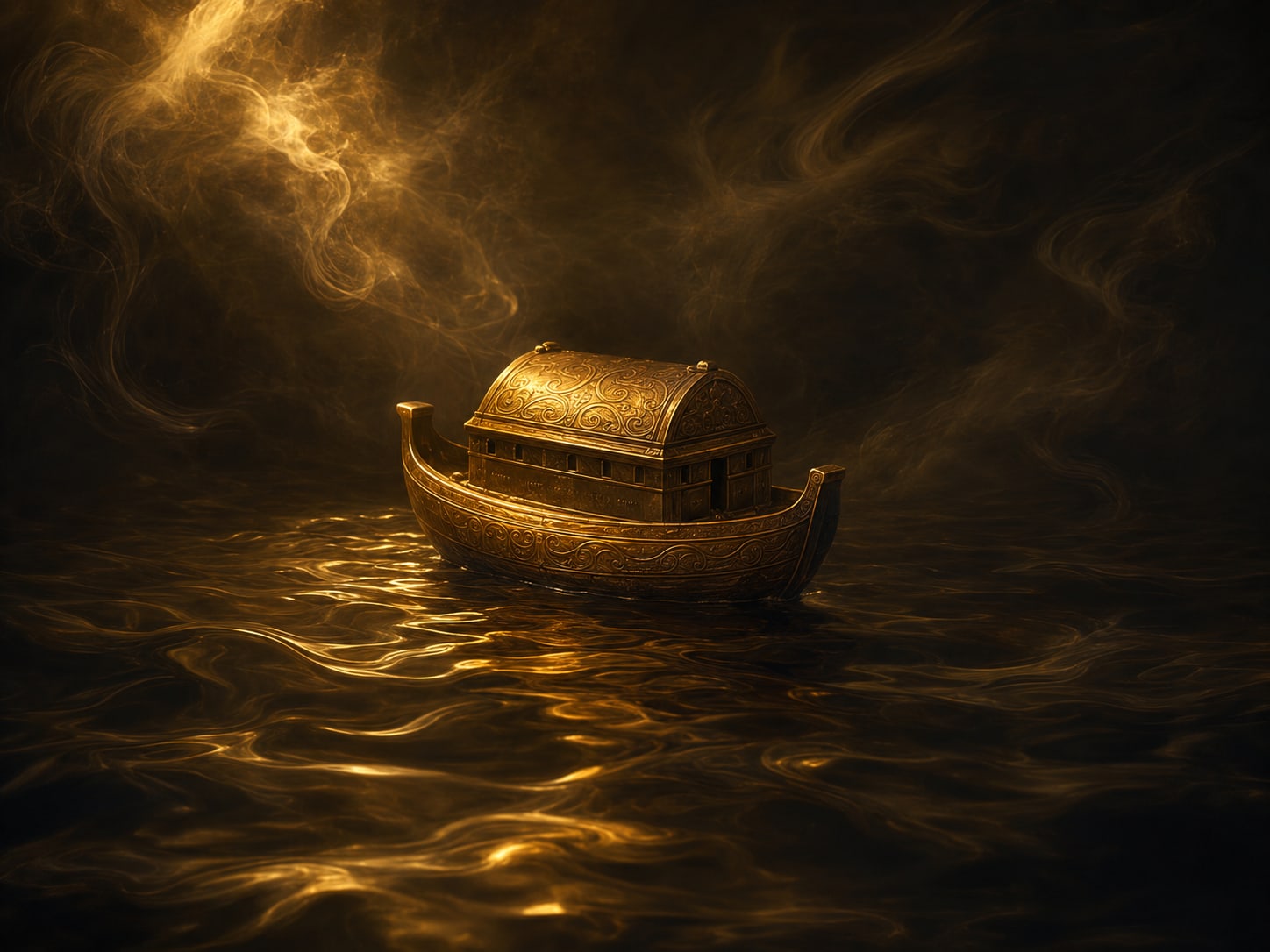
The biblical anchor is the Flood itself. Genesis 6 through 9 tells the story of Noah: a world washed away in judgment, a remnant carried through the water, and a covenant on the far side of it. Held as narrative, the story gives the flood a double weight that has shaped the symbol ever since, destruction and fresh start bound together in the same water. It is a way of thinking about what floods mean in the human imagination, not a code for decoding a dream, and nothing in the passage treats a dreamed flood as a sign of a real one. Scripture also uses floodwater as a picture of inner distress: Psalm 69 opens with the cry of someone in deep waters with the flood sweeping over them, and Isaiah 43 offers the counterweight, a promise of passing through the waters without being overwhelmed. Read side by side, the two verses hold the same pair the dream holds, the feeling of being overrun and the hope of coming through. The flood sits alongside many other scriptural images in our guide to biblical dream symbols from A to Z.
The Islamic tradition carries its own telling. Surah Hud, in verses 25 through 49, recounts the flood of the prophet Nuh, again as sacred narrative rather than dream instruction. Later interpretive traditions associated with Ibn Sirin are sometimes cited as reading floodwater in dreams as powerful change or an overwhelming authority, though these are later attributions, not a rule from the Qur'an itself, and they are best held loosely. For the dream side specifically, a hadith in Sahih Muslim, number 2262, gives believers a practical response to a disturbing dream, seeking refuge and not letting the dream dictate fear, which is notably a posture toward the dream rather than a decoding of it.
The flood story is also older and wider than any one scripture. Mesopotamian tradition tells of Utnapishtim, who survives a great deluge in the Epic of Gilgamesh; Hindu tradition tells of Manu, warned of the coming waters by a fish; Chinese tradition honors Yu the Great, who tamed the floodwaters rather than merely surviving them. The details differ, but the pattern repeats across cultures: the flood as the end of one order and the hard beginning of another. Modern spiritual readings soften the same pattern into cleansing and emotional release, the flood as a washing away that clears ground for something new. All of these are beliefs and stories held for reflection. If a flood dream feels spiritual to you, the traditions offer rich language for it; what none of them offers is a forecast.
05Key scenarios and variants
Flood dreams arrive in a handful of recognizable versions, and each bends the core theme of exceeded capacity in its own direction. Read your scene for its feeling first, then use these as prompts.
- A flood inside your house tends to make the overwhelm private, pressure reaching into home, family, or the parts of life you think of as yours; it is distinct enough to have its own guide.
- Escaping the flood, by car, by stairs, by high ground reached just in time, often mirrors coping and the search for a way out, and sometimes the wish for an exit you have not found in waking life yet.
- Dirty or brown floodwater tends to add confusion to the pressure, a situation you cannot see into; the murk itself is a rich enough symbol that muddy water dreams get their own reading. Clear floodwater keeps the emotion visible: a lot of feeling, but feeling you can name.
- Water receding is the recovery scene. The dream may still look wrecked, but falling water often mirrors a pressure past its peak, the beginning of taking stock rather than bracing.
- A flood carrying things away, cars, furniture, whole buildings, leans the reading toward loss and forced change, what the hard season took or rearranged rather than what it demanded of you.
- Being rescued from a flood often reflects support you have, or support you quietly wish would arrive, and who does the rescuing can be worth noting.
- A recurring flood dream tends to track an ongoing pressure rather than a new one, the same unresolved load surfacing on repeat.
- Going under the floodwater shifts the dream into drowning territory, the most personal version of the water symbol, covered in full in the drowning guide.
06Common questions about flood dreams
Does a flood dream mean my emotions are out of control?
Not necessarily. The flood is a useful metaphor for feeling or pressure past its usual boundaries, but it is a metaphor, not a fixed code. Some flood dreams track emotion, others track workload, change, or a situation that simply outgrew your plans for it. Start from the feeling the dream left you with and ask what in waking life carries the same charge.
Is a flood dream a warning?
Not reliably, no. There is no good evidence that flood dreams predict real floods, disasters, or bad news. What they reflect, at most, is a pressure you are already living with, which means the useful response is reflection rather than dread. If a dream nudges you to notice a load you have been minimizing, that is the closest thing to a warning it can honestly offer.
What does it mean if my home floods in the dream?
A flooded home tends to bring the overwhelm indoors, into family, household, or the private life you keep behind your own door. It often surfaces when pressure has stopped staying neatly at work or out in the world and has begun to reach the parts of life you count on as a refuge. The scene is distinct enough that we give it a full guide of its own.
What does dirty flood water mean, compared to clear?
Muddy or dirty floodwater tends to layer uncertainty on top of the pressure, a situation that feels both too much and hard to see into. Clear floodwater keeps the emotion visible and nameable. The two readings differ mainly in how well you feel you understand what is overwhelming you.
What does it mean if the flood water is going down?
Receding water is often the most hopeful frame in the whole symbol. It tends to mirror the aftermath of a hard stretch, pressure past its peak, the point where you can begin to assess rather than brace. The dream may still show damage, which fits; recovery is rarely tidy.
Why do I keep dreaming about floods?
A recurring flood usually points to an ongoing pressure rather than a series of new ones, the same unresolved load finding the same image night after night. Rather than fearing the repetition, treat it as a pointer to whatever the water keeps standing in for. If the dreams are frequent, wreck your sleep, or leave lasting distress, that is worth raising with a clinician.
What does the Bible say about flood dreams?
Scripture tells flood stories, most centrally Noah's flood in Genesis 6 through 9, and uses floodwater as an image of distress in Psalm 69 and of deliverance in Isaiah 43. What it does not do is interpret flood dreams; no passage treats a dreamed flood as a sign of a real one. The stories offer narrative context, judgment and fresh start held together, and they are read as belief, not as a dream code.
Reading your flood dream
A flood dream most often reflects what?
The most useful first detail to check in a flood dream is:
Flood stories like Noah's in Genesis are best held as:
Pick an answer to begin.
Whatever the water covered, the next step is the same: read the flood in your own context rather than as an omen. Find the water line, note whether it was rising or receding, and ask what in your waking life has passed the level you can comfortably hold. Look up the water entry in the dream dictionary at DreamTold, or browse the wider dream dictionary for the symbols that shared the scene. This is a guide for reflection, not medical advice; if flood dreams are frequent or distressing, a qualified professional can help.
Dream terms
Tap a term to see what it means.
Continuity of dreaming. The idea that dreams carry on the moods and concerns of waking life rather than breaking from them, so an overloaded season can surface as rising water.
Emotional processing. The mind's work of sorting through feeling, stress, and memory, much of which is thought to happen during sleep and dreaming.
The unconscious. The part of the mind outside everyday awareness, pictured in the depth psychology tradition as deep water that can breach its banks in dreams.
REM sleep. The sleep stage where the brain is most active and vivid dreaming is most likely, marked by rapid eye movement and relaxed muscles.
Symbolic overwhelm. Reading an image like a flood as a stand-in for pressure past capacity, a lens for reflection rather than a fixed code or prediction.
07Sources
Every claim on this page that comes from somewhere else, with the somewhere else. Scripture and hadith are linked so you can read them in context rather than trusting a paraphrase.
Related
articles.

Flood in the House Dream Meaning: Overwhelm at Home
What a flood inside your house means in a dream, read room by room, rising or receding, with biblical and Islamic angles held as belief. A no-omens guide.
Read: Flood in the House Dream Meaning
Lake Dream Meaning: Still Water, and What Is Under It
A lake is water that is not going anywhere. That stillness is what separates it from the ocean and the flood, and it is where the meaning of the dream sits.
Read: Lake Dream Meaning
Clear Water Dream Meaning: Calm, Clarity, and Reading Your Own Emotions
What clear water in a dream means: emotional clarity, calm, and seeing your situation truly, plus how swimming, drinking, and clouding water change the read.
Read: Clear Water Dream Meaning