

Spider Dream Meaning: Webs, Fear and Creativity
What a spider in a dream means, from feeling trapped in a web to the patient weaver of creativity, read by the spider's behavior and your feeling. No omens, no verdicts.
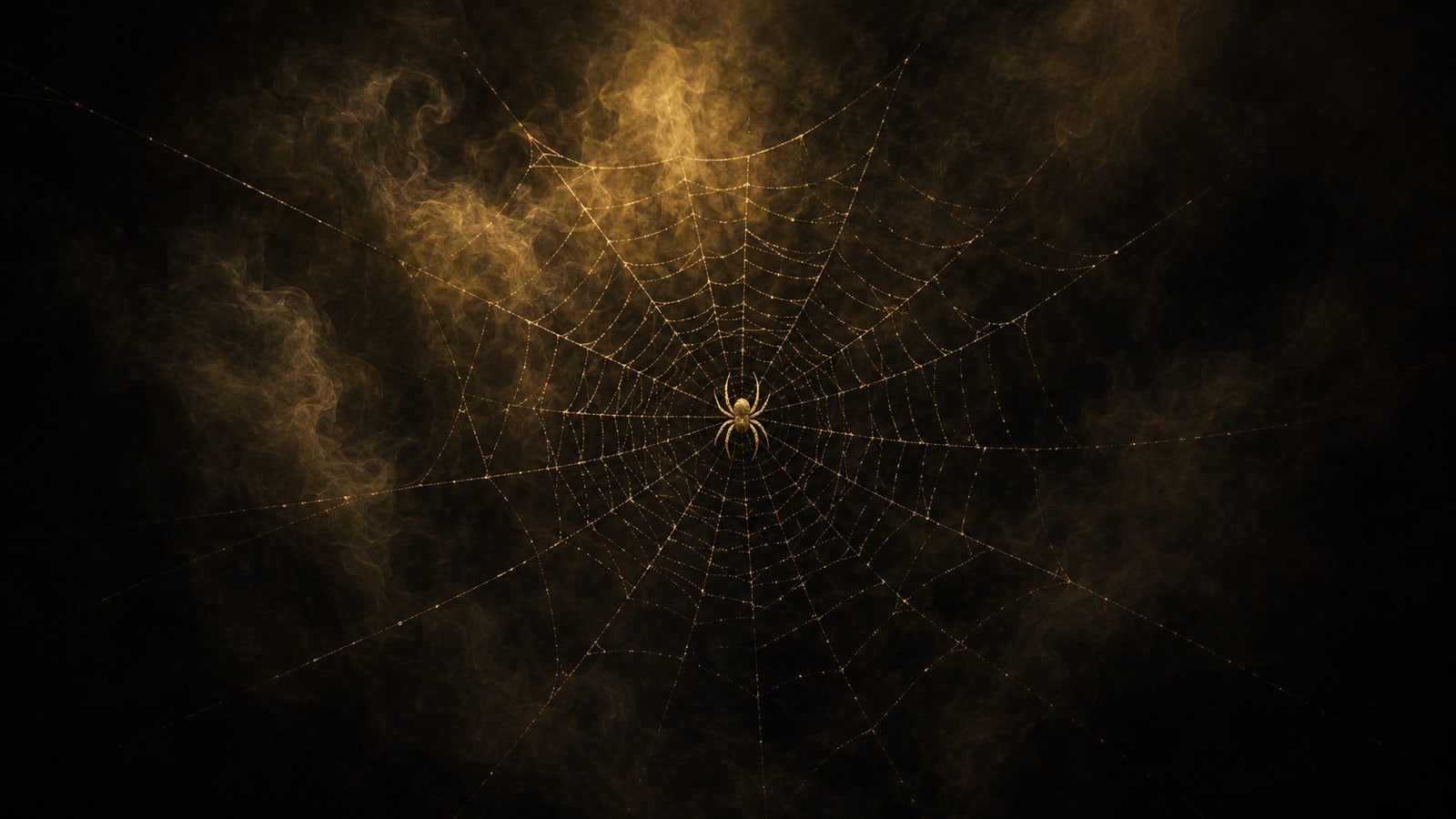 Featured
A spider in a dream usually points in one of two directions: a situation that feels carefully woven around you, or the patient, creative work of building something thread by thread. Which one applies depends on what the spider was doing and how you felt watching it. The dream does not identify a real manipulator, and it does not predict anything. It tends to borrow the spider because few images carry both entanglement and craftsmanship so well.
Key Takeaways
Two readings, one symbol
A spider can stand for feeling trapped or deceived, or for patience and creative work; the scene decides which.
Behavior is the key
A spider spinning, waiting, biting, or crawling on you each tells a different emotional story.
Feeling beats appearance
The emotion you woke with is a better guide than the spider's size or color.
Fear is often just fear
For many dreamers a spider is simply a common phobia surfacing, not a hidden message.
Tradition, not fact
Biblical, Islamic, and cultural readings are belief and reflection, never prediction.
Reflection, not accusation
A spider dream is a prompt to examine a situation, not evidence against a real person.
01The most common meaning
The most common reading of a spider dream is entanglement: a situation, relationship, or obligation that feels sticky, layered, and hard to back out of. A web is built to hold what touches it, and the dreaming mind reaches for that image when something in waking life feels quietly binding. That can be a commitment that grew past what you agreed to, a conflict where every move seems to tighten things, or a dynamic where you suspect someone is arranging events around you. The dream gives the feeling a shape; it does not confirm that anyone is actually scheming.
The second reading is the spider as weaver. A spider builds a complex, functional structure out of material it produces itself, one strand at a time, and then waits with a patience most of us envy. Dreamed in that register, a spider can reflect a project you are constructing, a plan coming together slowly, or your own capacity for detailed, careful work. Some dreamers meet the spider at the center of its finished web and wake with a sense of order rather than dread.
The honest answer is that the symbol splits, and the split runs through your own reaction. Watching a spider work from a distance sits very differently from finding one crawling up your arm. Before reaching for any interpretation, ask two questions: what was the spider doing, and what did you feel? A spider spinning while you watched calmly leans toward the creative reading. A web across your path, or threads on your skin, leans toward entanglement. The same instinct applies to the other classic feared creature; our guide to dreams about snakes walks through the same behavior-first reading for a symbol that splits just as sharply.
02The psychology of spider dreams
There is a plain explanation that deserves to come first: spiders frighten a lot of people. Arachnophobia is one of the most common specific fears, and the dreaming brain draws heavily on what carries emotional charge. One leading idea in dream science, threat-simulation theory, holds that dreams evolved partly to rehearse detecting and responding to danger in a safe setting. Small, fast, easily missed threats are exactly the kind of thing such a system would practice on. Under that view, a spider dream is often a fear drill rather than a message, which is why it can feel intense out of all proportion to anything happening in your life. The wider mechanics of how the sleeping brain builds these scenes are covered in our guide to why we dream.
Depth psychology adds lenses worth knowing, held as interpretation rather than proof. Freud's approach treated unsettling dream images as disguised versions of buried conflict, so a spider might stand in for something the waking mind avoids naming. Jungian writers have often linked the spider to feminine archetypes, and the link cuts both ways. On one side sits the weaver, an old image of creation, craft, and fate spun as thread. On the other sits the smothering or devouring side of the mother archetype, a closeness that binds rather than holds. Neither reading is settled science, and neither should be pinned on a real person in your life. They are ways of asking whether the dream is about something you are making or something you feel caught in.
Modern research leans on a simpler mechanism: sleep helps the brain process emotion, and unresolved feelings surface easily in dreams. A period of feeling controlled, obligated, or quietly maneuvered gives the sleeping mind exactly the charge a web image carries. Equally, a stretch of absorbing creative work can seed dreams of building and weaving. The spider is available to both because it genuinely does both, and the dream borrows whichever half matches the feeling you carried to bed.
03How the scene changes the meaning
A spider dream is read best as a whole scene: the spider's behavior, your position in it, and the feeling that lasted after waking. The grid below is a starting point for reflection, not a verdict.
Hover or tap a row to highlight it.
| Spider scene | What it often reflects | The emotional read |
|---|---|---|
| Watching a spider spin its web | Slow, patient work coming together | Absorbed, sometimes admiring |
| Caught or tangled in a web | A binding situation or obligation | Trapped, maneuvered, stuck |
| A giant spider | A worry that has grown to fill the room | Overwhelmed, dwarfed by a problem |
| Many spiders at once | Multiple small stressors rather than one big one | Scattered, crawling unease |
| A spider bite | A sharp emotional impact that got through | Stung, suddenly alert |
| Killing a spider | Confronting a fear or ending an entanglement | Relieved, back in control |
| A spider in your bed | Unease reaching your most private space | Exposed where you expect safety |
| A spider crawling on your body | A worry that feels personal and physical | Invaded, unable to shake something off |
Color and size are best treated as intensity dials rather than a code. A black spider tends to darken whatever the scene already means, pulling it toward the unknown or a fear kept in shadow, and a giant spider usually signals that a worry has outgrown its actual size in your life rather than naming a bigger enemy. A small spider ignored in a corner can be a minor irritation you have decided to live with. If the spider chased you, the dream may be running the standard pursuit pattern, where the urge to get away matters more than what pursues; our being chased dream meaning guide covers that pattern in full.
04Spiritual and biblical meaning of spiders
Spiritual readings of spider dreams are widely searched, and they are best held as belief and tradition rather than fact. What stands out across traditions is that the split reading appears there too: the web as something fragile and deceptive, and the weaver as a figure of skill and creation.
In the biblical tradition, spiders appear as images of fragility rather than as dream omens. Job 8:14 compares the hope of the godless to a spider's web, something leaned on that gives way. Isaiah 59:5 uses spider webs as a picture of schemes that cannot cover or protect anyone. Neither passage is a rule for interpreting dreams; both are literary comparisons, and the honest reading is that scripture uses the web to say some structures look finished but cannot bear weight. Dreamed in that spirit, a web can prompt the question of whether something you rely on, or something being spun around you, would actually hold. For how this kind of symbol reading works across scripture more broadly, see our guide to biblical dream symbols.
In the Islamic tradition, the Quran itself uses the spider as a parable rather than a dream sign: Quran 29:41 compares those who take protectors other than God to a spider building its house, and calls the spider's house the frailest of houses. The interpretive dream tradition associated with Ibn Sirin came later and is cited as tradition, not as the Quran. In accounts from that tradition, a spider in a dream is variously read as a weak but cunning person, or in some accounts as a devout, withdrawn figure, which is a reminder that even inside one tradition the readings differ. None of this predicts events or identifies anyone. Our overview of what Islam says about dreams covers how that tradition frames dream interpretation as a whole.
Other traditions carry the weaver side more strongly. In Greek myth, Arachne is the mortal weaver whose skill and pride end in her transformation into a spider, tying the creature permanently to craft. In Akan tradition from West Africa, Anansi the spider is a trickster whose cleverness wins him the world's stories, a figure of wit rather than menace. In Hopi tradition, Spider Grandmother appears as a creator and helper. New Age writers often read the web as creativity and interconnection, every strand touching every other. Held together, these beliefs suggest why the spider refuses a single meaning: cultures have long seen in it both the schemer and the maker. Whichever tradition speaks to you, treat the dream as an invitation to reflect within your own beliefs, not as a forecast.
05Key scenarios and variants
Spider dreams arrive in a handful of recognizable versions, and each bends the central split its own way. Read the feeling first, then use these as prompts. Several are common enough to deserve their own full reading, which we are adding over time.
- A giant spider usually means the worry, not the enemy, has grown. Something manageable in daylight has taken up the whole room at night, and the useful question is what has been allowed to inflate.
- A black spider tends to pull the scene toward the unknown, a fear you have not named yet, while a white or pale spider often reads as a gentler, more neutral presence; let the feeling decide.
- Many spiders at once usually point to accumulation, a dozen small obligations or irritations rather than one large threat, the to-do list made mobile.
- A spider web on its own, without the spider, can go either way: craftsmanship and connection if you admired it, entanglement if you had to pass through it.
- A spider bite often marks a sharp emotional impact, the moment a background unease finally reached you, closer in spirit to a sting than a wound.
- Killing a spider is commonly experienced as confronting a fear or cutting off an entanglement, and it often leaves relief behind rather than guilt.
- A spider in your bed or house brings the symbol into your own territory, which usually means the unease belongs to home, family, or private life rather than work.
- A spider crawling on your body is the most invasive version, a worry that feels personal, physical, and hard to brush off, and it is also the version most likely to be plain phobia doing its work.
If spider dreams keep returning as distressing nightmares, the repetition matters more than the spider. Our nightmares guide covers when recurring bad dreams are worth raising with a professional, and the spiders entry in the dream dictionary collects the core symbolism in one concise place.
06Common questions about spider dreams
Is it good or bad to see spiders in a dream?
Neither, on its own. The spider carries a genuinely split symbolism, entanglement and fear on one side, patience and creativity on the other, and the scene decides which applies. A spider calmly building while you watched is a different dream from one crawling on your skin, even though both answer to "I dreamed about spiders."
Why did spiders appear in my dream?
The most likely reasons are ordinary: spiders are a common fear, and the dreaming brain rehearses what carries emotional charge. Beyond that, spider dreams often follow periods of feeling obligated, maneuvered, or stuck in something sticky, and sometimes periods of absorbing, detailed work. Look at what the spider was doing and match it to what currently feels woven around you or by you.
What is the spiritual meaning of a spider in a dream?
In spiritual traditions the spider is double-sided. Scripture uses the web as an image of fragile reliance, myth and folklore honor the spider as weaver, trickster, and creator, and New Age readers often treat the web as interconnection. All of these are belief systems rather than facts about your future, so the grounded approach is to read the dream within the tradition you actually hold.
What does the Bible say about spiders in dreams?
The Bible does not give a rule for spider dreams. Its spider references are images in poetry and prophecy: Job 8:14 likens misplaced hope to a spider's web, and Isaiah 59:5 uses webs for schemes that cannot protect. Applied reflectively, both ask whether a structure in your life would hold weight, which is a question, not an omen.
What does a spider dream mean in Islam?
Quran 29:41 uses the spider's house as a parable of the frailest reliance, and the later interpretive tradition associated with Ibn Sirin variously reads a dream spider as a weak but cunning person or, in some accounts, a devout recluse. These are cited as tradition and belief, not prediction, and they are never grounds to accuse a real person of scheming.
What does a giant spider dream mean?
A giant spider usually magnifies feeling rather than fact. It tends to appear when a worry, obligation, or fear has grown out of proportion, so the dream renders it at the size it occupies in your attention. The useful follow-up is to name the thing that has been quietly expanding and check its real dimensions in daylight.
Does dreaming of a spider mean someone is manipulating me?
No dream can establish that. The web-spinner is an old image for manipulation, so the dream may be voicing a suspicion or a feeling of being maneuvered, and that feeling is worth examining honestly. But a spider dream is not evidence about any real person, and acting on it as if it were is the one clearly wrong reading.
Reading your spider dream
The spider's split symbolism means a spider dream is best read by:
In Quran 29:41, the spider's house is used as a parable of:
A dream of many small spiders most often reflects:
Pick an answer to begin.
Whatever your spider was doing, the next step is the same: read the scene against your own life rather than as an omen, and notice whether you met the trap or the weaver. Explore the rest of the dream dictionary at DreamTold and follow the detail that stuck with you.
Dream terms
Tap a term to see what it means.
Threat-simulation theory. The idea that the dreaming brain rehearses detecting and escaping danger in a safe setting, one leading explanation for why feared creatures like spiders show up so often.
Arachnophobia. The specific fear of spiders, one of the most common phobias, and a frequent plain-sense reason spiders appear in dreams.
Archetype. In Jungian thought, a recurring symbolic figure the mind draws on, such as the weaver or the devouring mother, used as a lens rather than a fact.
Anansi. The spider trickster of Akan tradition in West Africa, a figure of cleverness and storytelling that carries the spider's creative side.
Manifest content. The literal story of a dream, the images you actually remember, such as the web, the crawling, or the bite.
07Sources
Every claim on this page that comes from somewhere else, with the somewhere else. Scripture and hadith are linked so you can read them in context rather than trusting a paraphrase.
- BibleGateway: Isaiah 59:5
- BibleGateway: Job 8:14
- Ibn Sirin dictionary (PDF): Ibn Sirin
- Quran.com: Quran 29:41
Related
articles.
Black and White Striped Snake Dream Meaning: Duality Explained
Black and white striped snake dream meaning: a black and white choice, a camouflaged warning, and what several traditions each say it means.
Read: Black and White Striped Snake Dream Meaning
Red and Black Striped Snake Dream: Is It a Warning?
Woke up shaken by a red and black striped snake dream? Learn what the coral snake connection is, why fear matters more than color, and what traditions say.
Read: Red and Black Striped Snake Dream
Black Cat Dream Meaning: Luck, Warning, and What the Superstition Misses
A black cat in a dream usually reflects instinct, privacy, and boundaries. What the cat was doing carries the meaning, and the luck belief is regional.
Read: Black Cat Dream Meaning