

Dream of Snake Eating Another Snake: Unraveling the Symbolism and Myths
What a snake eating another snake in a dream reflects: one conflict consuming another, read by size, fear, and the ouroboros. Biblical and Islamic readings, honestly labeled.
 Featured
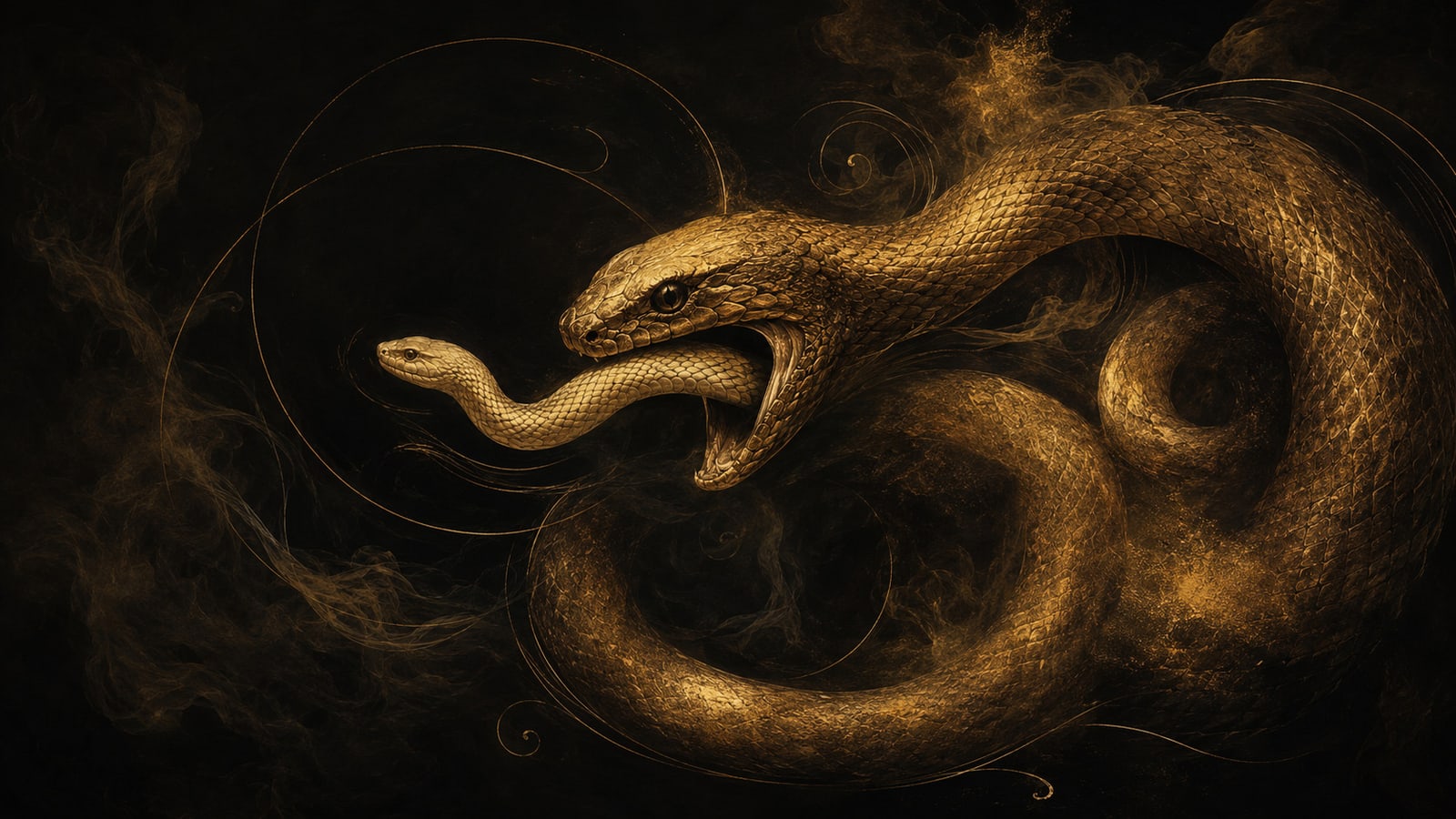
A snake eating another snake in a dream usually reflects a conflict that feels consuming: one fear, pressure, relationship, or version of you seems to be overpowering another. The details do the interpretive work: the size of the two snakes, whether you were afraid or fascinated, and whether the snake was eating another snake or its own tail all change the reading. What the dream does not do is predict a death, a betrayal, or a real person's defeat.
Key Takeaways
Conflict consuming conflict
The image usually stages one pressure or fear overpowering another, often inside your own life.
Not the ouroboros, usually
A snake eating its OWN tail is the ancient renewal symbol; one snake eating another is a different image about dominance and absorption.
Not an omen
No scripture assigns this dream a meaning; enemy-defeat readings come from later manuals and folklore.
Nature does this
King snakes and king cobras really do eat other snakes, so the image is not as alien as it feels.
01What makes this image different from an ordinary snake dream
A single snake in a dream tends to carry threat, distrust, or change, the territory our full guide to dreams about snakes maps in detail. Two snakes, one consuming the other, add a second layer: relation. The dream is no longer just showing you something charged; it is showing you two charged things interacting, and one of them winning. That is why people wake from this dream with such a specific unease. It feels less like an encounter and more like a verdict.
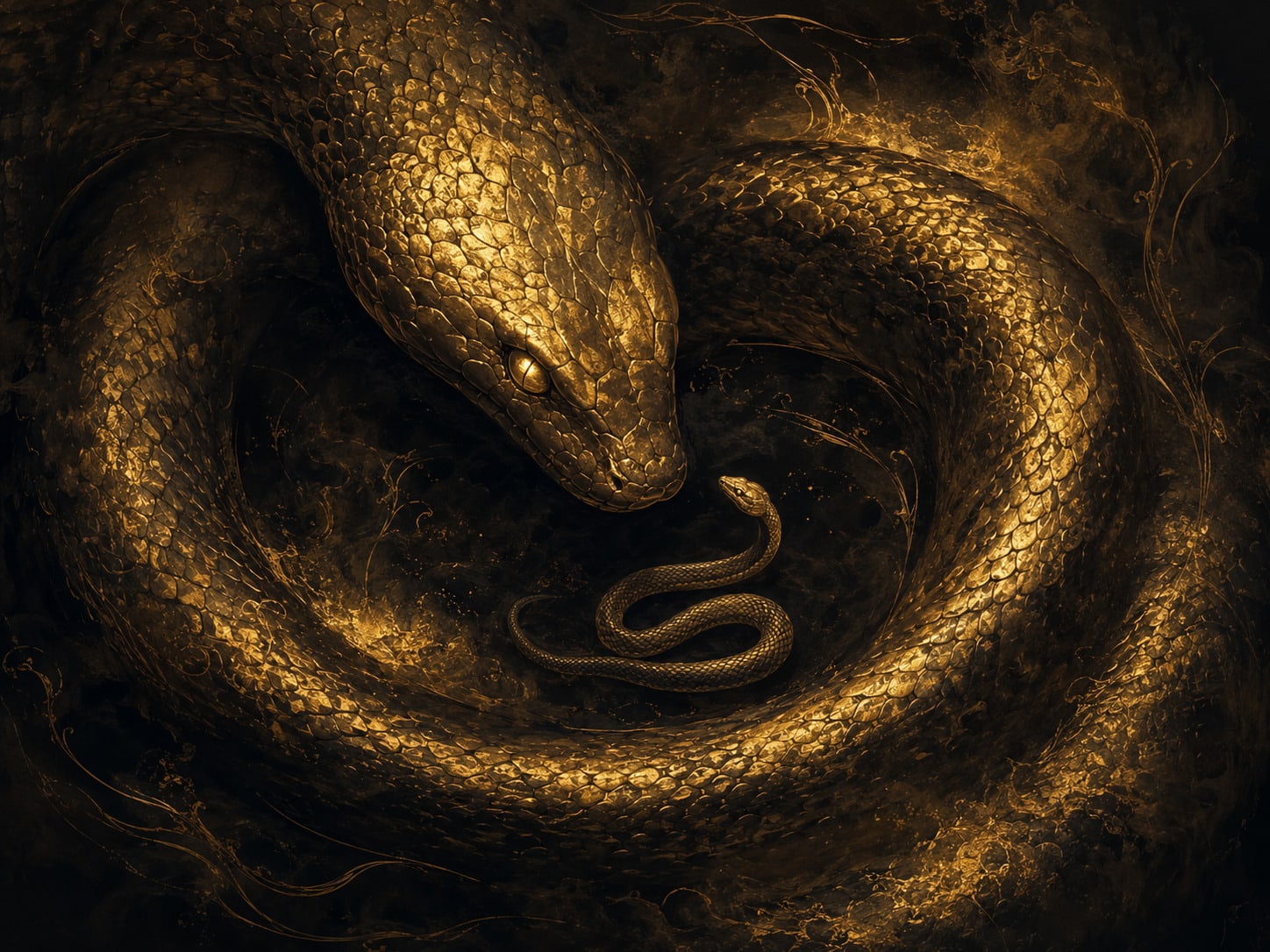
Read reflectively, the verdict is usually internal. One worry has grown until it swallows the others. One demand in your life, a job, a conflict, a person's needs, is absorbing everything around it. Or one version of you is overtaking another: an old habit consuming a new resolution, or, more hopefully, a new sense of self absorbing an old fear. The swallowing is the point. Ask what in your waking life feels like it is being consumed, or doing the consuming, and the dream usually snaps into focus.
It is also worth one honest line of natural history: snakes eating other snakes is real. King snakes are named for it, and the king cobra's scientific name, Ophiophagus, literally means snake-eater. If you have ever seen that footage, your dreaming brain has the image on file. Not every vivid dream needs a symbolic engine; sometimes memory supplies the props.
02The psychology of a snake eating a snake
Dream science treats an image like this as emotionally driven scene-building, not a coded message. During REM sleep the brain dramatizes feeling with whatever imagery carries the right charge, and threatening or conflict-heavy scenes are common: threat-simulation theory reads them as rehearsal, and research links presleep rumination, the worry you carry to bed, with more threatening dream content. A consuming conflict in waking life makes a consuming image in dream life; the translation is almost literal.
The disgust matters too. Many people wake from this dream less frightened than repelled, and disgust in dreams often flags something you find hard to look at directly: a conflict you consider beneath you, a rivalry you will not admit to caring about, a need that embarrasses you. In Jung's language, the swallowing snake makes a natural shadow figure, the disowned part asserting itself. That is an interpretive lens rather than a finding, but for this image it is often a productive one: ask not only what is being consumed, but which snake you secretly sided with.
03How the scene changes the meaning
Hover or tap a row to highlight it.
| Scene | What it often reflects | The emotional read |
|---|---|---|
| Big snake swallows small snake | A power imbalance you can feel | Overmatched, or quietly dominant |
| The smaller snake escapes | A conflict not yet decided | Resilience, unfinished business |
| Two snakes fighting first | Competing pressures at a standoff | Torn between demands |
| One snake swallowed whole | A problem that feels all-consuming | Engulfed |
| Snake eating its own tail | A cycle, not a conflict; the ouroboros image | Repetition, renewal, or being stuck |
| Snake eats a cobra | One fear overcoming another | Strange relief |
| In your house | Private or family conflict | Tension where you expect calm |
| In water | Emotional conflict below the surface | Feelings consuming feelings |
| You feed one snake | Participation in a power struggle | Complicit, uneasy |
| You kill the eating snake | Refusing domination or a feared pattern | Assertive, decisive |
Two rows deserve emphasis. First, size: the big-swallows-small version is the most common and the most pointed, and the question that unlocks it is which snake felt like yours. Feeling like the small snake mirrors being overpowered, absorbed, or crowded out. Feeling like the big one can mirror ambition or control, and sometimes an uncomfortable awareness of your own appetite in a conflict. Second, the tail: a snake eating its own tail is a different image with its own ancient history, covered below, and it points at cycles rather than rivals. Colors tint the feeling the way they do across snake dreams: a black snake doing the eating pulls the scene toward the unknown, a white one makes the force feel eerily calm.
04Spiritual and biblical meaning of a snake eating another snake
This dream has a genuine biblical near-parallel, and it is worth getting exactly right. In Exodus 7:10-12, Aaron casts down his staff before Pharaoh and it becomes a serpent; Pharaoh's magicians do the same with theirs; "but Aaron's staff swallowed up their staffs." The scene is a sign of the God of Israel's power over Pharaoh's court, serpent swallowing serpent as demonstration. It is a vivid and legitimately relevant passage, and it is not a dream code: nothing in Exodus tells a dreamer that one snake eating another predicts victory, judgment, or anything else. The other serpent passages keep their usual roles, the crafty serpent of Genesis 3, the healing bronze serpent of Numbers 21, the "ancient serpent" of Revelation 12:9, and none of them assigns this dream a meaning either. Our biblical dream symbols A to Z sorts what scripture actually supports from what gets attached to it.
The Islamic sources hold the same shape, and the parallel is striking: Quran 7:117, 20:69, and 26:45 describe Moses' sign swallowing what the magicians had faked. Again, a narrative of true power overcoming false display, not a dream rule. In the later manuals attributed to Ibn Sirin, the snake is concretely read as an enemy or enmity, and by extension one snake overcoming another has been read as one hostile force defeating another, enemies fighting among themselves. That reading is later interpretive tradition, not the Quran, and the hadith tradition counsels a distressed dreamer toward calm: Sahih Muslim 2261d directs seeking refuge in God and not fearing that the dream itself will cause harm. The fuller framework is in our guide to what Islam says about dreams.
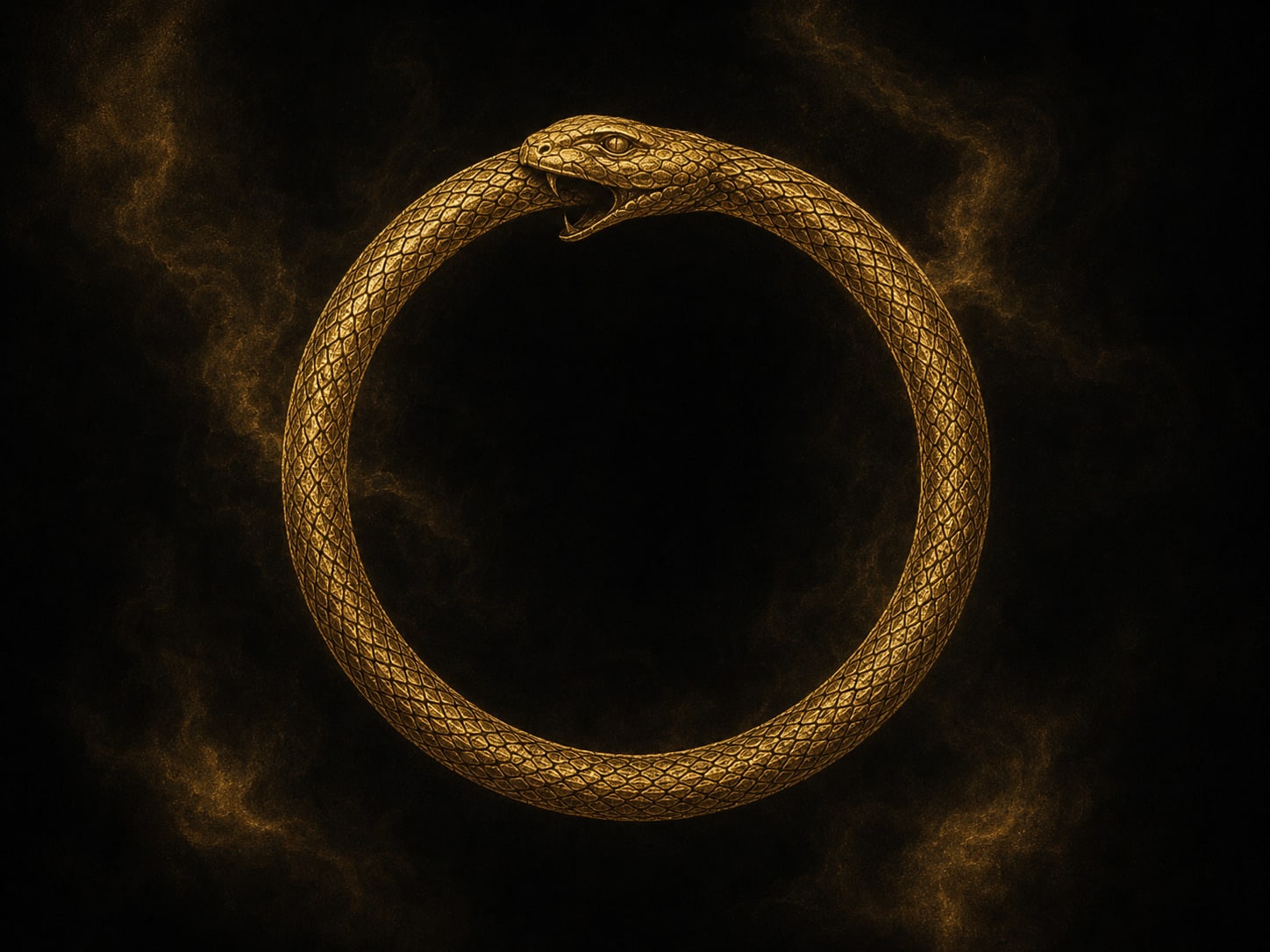
The wider traditions supply the image bank. The ouroboros, the serpent eating its own tail, runs from ancient Egyptian iconography through Greek and alchemical tradition as a symbol of cyclic renewal and self-containment; it is specifically a self-eating image, which is why it should not be stretched to cover one snake eating another. Greek myth gives the Hydra, the multiplying serpent adversary, for conflicts that grow heads faster than you can cut them. Hindu tradition holds Ananta Shesha, the cosmic serpent on whom Vishnu rests, a stability image that reminds you the serpent is not universally hostile. Modern spiritual writing often reads one snake consuming another as integration, an old identity absorbed by a new one, or a destructive pattern consuming itself. All of these are belief and tradition, useful as lenses, binding as nothing.
05Key scenarios and variants
- You watched from a distance. Spectatorship usually mirrors a power struggle around you rather than inside you: a workplace rivalry, a family conflict, two people you care about consuming each other while you stand by.
- You felt threatened next. If the eating snake turned toward you, the dream escalates from observation to implication: the winning force in some conflict feels like it is coming for you or your standing.
- You felt nothing, or fascination. Calm in front of a violent image often means the conflict is one you have already processed, or one you observe with more detachment than you admit. Fascination without fear is common and not a red flag.
- The image recurs. A repeating consuming image suggests the underlying pressure is ongoing. Recurring distressing dreams respond to the same approaches covered in our nightmares guide.
- It ended in a bite. If what lingers is the strike rather than the swallowing, read it alongside snake bite dreams, where the bite's location and pain carry the weight.
06Common questions about snake eating snake dreams
Is a snake eating another snake an ouroboros?
Only if it is eating its own tail. The ouroboros is specifically a self-consuming circle, an ancient symbol of cycles, renewal, and containment found in Egyptian iconography and later alchemy. One snake eating a different snake is a conflict-and-absorption image, not a cycle image. The distinction matters because the two point in different directions: the ouroboros asks what keeps repeating; the two-snake version asks what is overpowering what.
Does it mean one of my enemies will defeat another?
That is the reading the later Ibn Sirin-attributed manuals support, snake as enemy, one enmity consuming another, and it survives in folk belief as "enemies fighting among themselves." It is tradition, not evidence, and it should be held as belief. The grounded version of the same intuition: the dream may reflect your sense that two conflicts or rivals in your life are colliding, without promising any outcome.
What does a big snake eating a small snake mean?
Size usually maps to power. This version tends to mirror an imbalance you feel: a demand, person, or fear that is simply bigger than what it is consuming. The most useful question is which snake carried you, because the dream reads very differently from inside the big snake than from inside the small one.
What does Exodus 7 actually say?
That Aaron's staff became a serpent before Pharaoh, the magicians' staffs did likewise, and Aaron's serpent swallowed theirs (Exodus 7:10-12). It is a sign narrative about God's power over Pharaoh's court. It is the closest scripture comes to this dream's image, and it still assigns no meaning to the dream; using it as a personal victory prophecy stretches the text past what it says.
Is this dream a warning?
No tradition's scripture makes it one, and dream science gives dreams no predictive power. What the dream can honestly do is inform you: it can tell you that some conflict has grown consuming enough that your sleeping mind is staging it. That is worth acting on as self-knowledge, never as forecast, a distinction our guide to dream omens and warnings walks through.
Can stress cause a dream like this?
Yes, in the ordinary sense that stressful, ruminative periods reliably produce more threatening dream content; research links presleep rumination with exactly that. A violent, consuming image during a consuming stretch of life is the dream system working normally, not malfunctioning.
Reading your snake eating snake dream
A snake eating another snake in a dream most often reflects what?
When is the image an ouroboros?
What does Exodus 7:10-12 establish about this dream?
Pick an answer to begin.
A snake eating another snake is one of the most visceral images a dream can serve, and its power is exactly what makes it worth reading carefully instead of fearfully. Start with what was consuming what, which snake felt like yours, and what in your waking life carries that same all-absorbing charge. DreamTold treats dreams as a window into your own mind, so look up the images that stayed with you in the dream dictionary and read them in your own context. This guide is educational and meant for reflection, not medical advice; if distressing dreams or sleep problems are affecting your daily life, speak with a qualified clinician.
Dream terms
Tap a term to see what it means.
Ouroboros. The ancient symbol of a serpent eating its own tail, from Egyptian iconography through Greek and alchemical tradition; it represents cycles and renewal, not rivalry.
Ophiophagy. Snake-eating; real behavior in king snakes and the king cobra, whose genus name Ophiophagus means snake-eater.
Hydra. The multiplying serpent adversary of Greek myth, an image for conflicts that grow faster than they are cut down.
Ananta Shesha. The cosmic serpent of Hindu tradition on whom Vishnu rests, a serpent image of stability rather than threat.
Presleep rumination. Looping worry carried into sleep, which research links to more threatening dream content.
07Sources
Every claim on this page that comes from somewhere else, with the somewhere else. Scripture and hadith are linked so you can read them in context rather than trusting a paraphrase.
- BibleGateway: Exodus 7:10-12
- Ibn Sirin dictionary (PDF): attributed to Ibn Sirin
- Quran.com: Quran 7:117
- Sunnah.com: Sahih Muslim 2261d
Related
articles.
Black and White Striped Snake Dream Meaning: Duality Explained
Black and white striped snake dream meaning: a black and white choice, a camouflaged warning, and what several traditions each say it means.
Read: Black and White Striped Snake Dream Meaning
Red and Black Striped Snake Dream: Is It a Warning?
Woke up shaken by a red and black striped snake dream? Learn what the coral snake connection is, why fear matters more than color, and what traditions say.
Read: Red and Black Striped Snake Dream
Killing a Snake in a Dream: Facing a Fear or Cutting Something Off?
What killing a snake in a dream means, read by your relief or unease and the snake's behavior, plus the biblical and Islamic readings. A grounded, no-omens guide.
Read: Killing a Snake in a Dream