

Spiritual Meaning of a Tree Branch Falling: Omens, Scripture, Safety
What it means when a tree branch falls in front of you or on you: what omen traditions and the Bible hold, and why the tree itself needs checking.
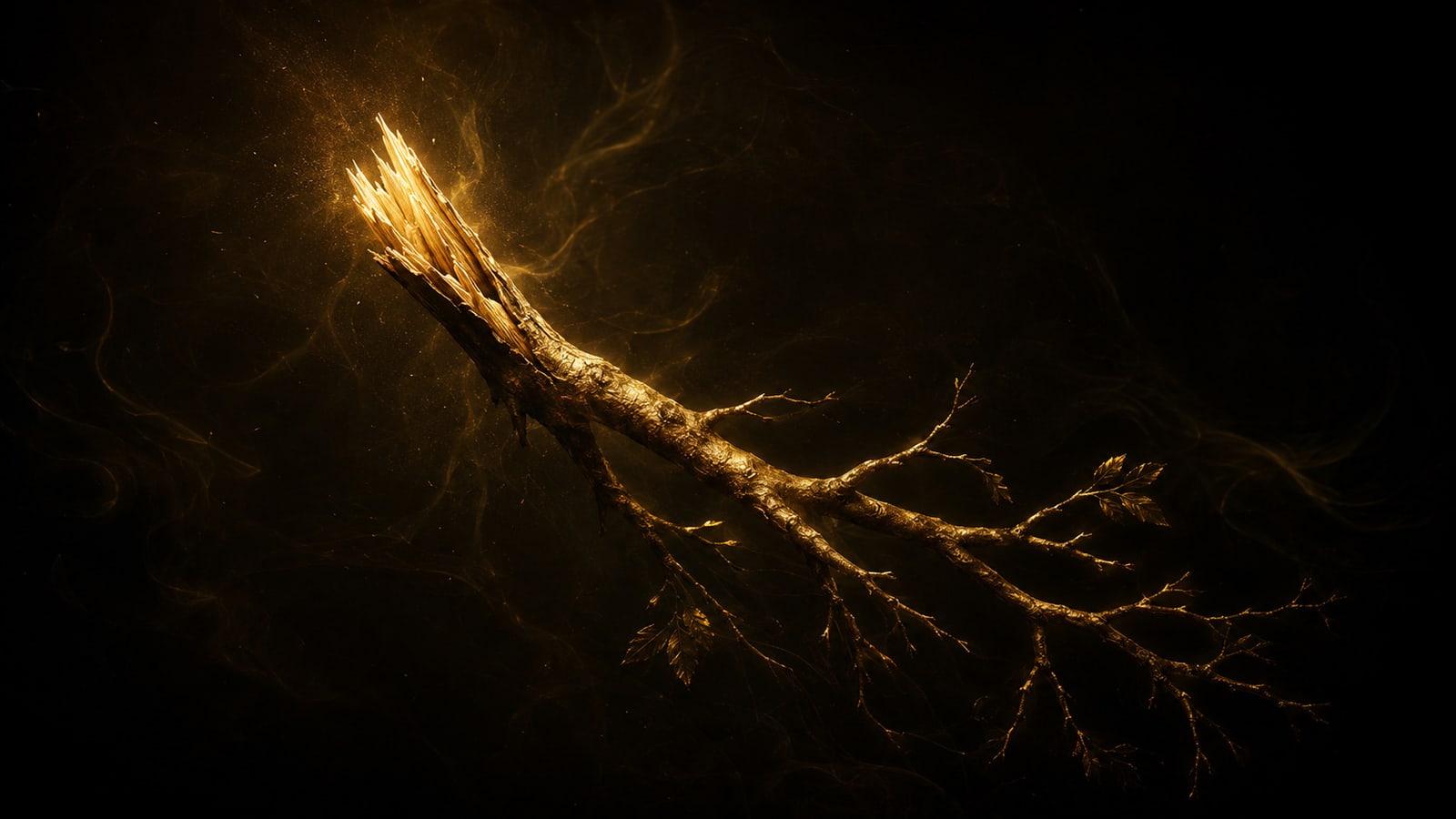 Featured
People who read a tree branch falling in front of you as a sign mostly read it as change: a warning to slow down, a close call you were spared, or a prompt to let go of something that has stopped growing. If the branch hit you, look after that first, since a knock on the head from a heavy limb is worth having checked, and then have the tree looked at, because the decay that drops one limb can drop another. Physically, branches come down from wind, rot, drought stress, age, or plain weight. The readings below come from Christian, Islamic, folk and modern spiritual traditions, and each is named as the belief of the people who hold it.
Key Takeaways
What traditions read into it
Folk belief and modern spiritual writers commonly take a falling branch as a sign of change, loss, pruning, or letting go.
What the Bible says
The Bible's tree passages speak of calling, pruning, fruit, and humility in their own contexts; none assigns a meaning to a branch falling near a person.
Why it fell
Storm load, internal rot, drought stress, old age, and the sheer weight of a long limb account for the overwhelming majority of falls.
Why it stays with you
A branch that lands during a hard week gets read as being about the hard week, which is how minds handle a sudden jolt.
Have the tree checked
A limb that came down unexpectedly often points to decay at the joint, and that is worth an inspection whatever the moment meant to you.
If you dreamed it
Dream research does not treat a dream image as a reliable forecast or diagnosis, so a dreamed branch is read through the feeling it left and what is going on in your life.
01What Christian tradition holds about trees and branches
Scripture does not assign a meaning to a branch falling. It does contain a rich set of tree images that Christian readers have long reflected on, held as tradition and belief rather than as a code for modern events, and these are the passages that come up.
Psalm 1 pictures the flourishing person as a tree planted by water, read as an image of stability and of being rooted in something that sustains you. Matthew 7 uses a tree and its fruit as a test of character, where what a tree produces reveals what it is. Daniel 4:10 to 17 describes a great tree cut down in a king's dream, read as a warning against pride within that narrative. Ezekiel 17:22 to 24 has a tender branch planted on a mountain and made to flourish, taken as an image of restoration. John 15:1 to 6 gives the vine and the branches, where pruning is presented as care rather than punishment, and Romans 11:17 to 24 uses grafted branches as an image of inclusion.
Every one of those belongs to its own narrative or teaching context. A Christian reader may find real meaning in the themes of rootedness, pruning, fruit, and humility after seeing a branch come down, and that reflection is a legitimate use of the text, while the passages themselves do not decode or predict a modern event. For the wider set of images, our guide to biblical dream symbols from A to Z works through them one by one.
Readings that tie a falling branch to sickness or attack
Some deliverance-focused Christian teaching reads a falling branch through what its preachers call spiritual codes. On Evangelist Joshua TV, one of the more visible channels, the readings offered run to hopelessness, sickness, death, and spiritual attack, and some symbol writers go further, connecting falling branches to a life cut short and to gravestones.
These are real positions, held sincerely by the communities that teach them. They are one strand of interpretation, and they are not scripture or the shared position of Christianity or of any single church. No study or scripture passage establishes that a branch coming down near a person indicates illness or an attack on them.
If a reading like this raised a specific worry about your health or your family, take that worry to a doctor, a trusted person, or your own faith leader, where it can be answered on its own terms.
02Is a falling branch an act of God?
This question arrives in two forms, and they have separate answers. In everyday and insurance language, "act of God" is a standard phrase for damage caused by natural forces with no human hand in it, and a limb brought down by a storm is a textbook example of what people mean by it. That usage is about liability and paperwork, and it carries no theological claim at all.
The other form is theological: did God cause this, and was it meant for me. Traditions answer that differently. A tree failing at a decayed joint has a complete physical explanation, and most religious traditions have never treated finding the physical explanation as the end of the question. If it matters to you, your own faith leader is the person to have that conversation with.
03What Islamic tradition holds, and other traditions
The Quran uses trees and branches in moral imagery, including the good word compared to a good tree in Ibrahim 14:24 to 26, and it treats dreams as significant in specific narratives such as the account of Yusuf in Yusuf 12:4 to 6 and 12:43 to 49. It does not provide a symbol dictionary and does not assign a meaning to a falling branch. Later interpretive traditions associated with Ibn Sirin may treat a tree as standing for a person or a household and its condition as symbolic, and that body of work is later interpretation rather than revelation. Our overview of what Islam says about dreams sets out that distinction in more detail.
Other traditions use their own frames. In ancient Greece, dream incubation at the healing sanctuaries called Asclepieia treated dreams as encounters needing interpretation within ritual rather than as free-standing signs. In Hindu thought, the Mandukya Upanishad discusses dreaming as a state of consciousness rather than an object-by-object code. Chinese Zhougong dream lore catalogues symbols as traditional omens, which is closer to the dictionary approach many readers expect. These are distinct historical traditions with distinct assumptions, and how dream interpretation differs across cultures traces those differences.
Modern spiritual writers add a further layer, commonly reading a falling branch as a prompt about release, transition, or letting go of something that has stopped growing. Those are symbolic beliefs, offered as prompts for reflection rather than as predictions that something will happen.
04The scenarios people search after it happens
A branch falling on your car
This is the most searched version and usually the most practical, because a limb on a vehicle is a damage and insurance matter first. Symbolically, people commonly read a car in a dream as independence, direction, or the ability to keep moving, so a branch landing on it attracts readings about a plan being interrupted or a route blocked. If that reading fits, the question it raises is how much the interruption is costing you.
A branch falling on your house
A limb hitting a roof frightens people most, because a house in a dream stands in for family, shelter, and safety in almost every symbolic system, and traditions that read houses this way connect the event to household strain or to protection. Keep the practical response first: roof damage and a compromised tree both need inspecting. The symbolic reading, whatever it brings, does not change what the tree will do in the next storm. Where the limb came down on you rather than on something you own, see to any injury before anything else. A branch falling on you is read differently again, because the target of the fall is the part the dream is emphasising.
A branch falling directly in front of you
The near miss is the one people find hardest to shake, and understandably. Something heavy landed where you would have been a second later, and the mind fills that gap immediately. People who take it as a sign tend to read it one of two ways, as a warning or as a rescue, and both come from the same reflex working in opposite directions. Others find it steadying to treat the moment as a reminder of how much of ordinary life runs on chance, which is a reasonable personal meaning to take from it.
Hover or tap a row to highlight it.
| Scene | What people commonly read into it | How that reading should be held |
|---|---|---|
| Branch falls on your car | Interruption to plans, momentum, or independence | Modern symbolic belief; the practical matter is damage and insurance |
| Branch falls on your house | Household strain, shelter, or protection | Modern symbolic belief; inspect the roof and the tree first |
| Branch falls in front of you | A near miss read as either a warning or a rescue | Personal meaning-making after a startling event, not evidence |
| Healthy branch breaks unexpectedly | Change or strain arriving without warning | Reflection prompt; the physical cause is usually internal decay |
| The same image recurs in dreams | An unresolved worry the mind keeps returning to | Consistent with dream research on recurring imagery |
| Tree and branch imagery in scripture | Calling, pruning, fruit, humility | Belief and tradition, tied to each passage's own context |
05Why branches fall
Wind and storm loading is the obvious cause: a gust twists a limb past what its attachment point can hold and the limb tears free. Internal decay is the quieter one. A branch can look leafy and healthy while the wood inside its base has been broken down by fungus for years, so the failure arrives without warning on an ordinary day.
Drought and heat stress add another path, because a tree under water stress sheds parts of itself and a slowly dying limb is far weaker than it was two summers ago. Age and weight finish the list. Long horizontal limbs carry a lot of leverage at the trunk, every year of growth adds load to a joint that was never engineered for it, and snow, ice, or a heavy crop of fruit can tip that balance in an afternoon.
The branch's reasons were worked out over years and ran to completion at the second you happened to be there. Why that second stayed with you is a separate question.
06Having the tree checked
If a branch came down near your home, your car, or a path you use, have the tree looked at. A limb that failed without a storm behind it often points to decay at the attachment, and decay does not stop after one branch. That is the practical response, whatever the branch meant to you.
The second thing is quieter. If the event or the dream left you shaken for days afterward, note what you were carrying at the time it happened. If the unease persists, disturbs your sleep, or has fed a fear that follows you around, talk to a qualified clinician, or to your faith leader if the concern is a spiritual one. Being frightened by something you read or watched is common, and it is easier to unpick out loud than alone at two in the morning.
07Why it felt like a sign
A branch falling is startling in a specific way. It is loud, it is sudden, it involves something meant to be permanently overhead, and it usually happens without a visible cause. Startling events pull attention hard, and attention is what turns an ordinary occurrence into a memory that keeps replaying.
After a jolt like that, the mind reaches for whatever story is already loaded. If you have been worrying about a parent's health, the branch reads as being about the parent. If you have been postponing a decision, it reads as pressure to decide. If you were already frightened, it reads as a threat. Your current state supplies the meaning, and it supplies it fast, which is why the interpretation arrives feeling like a revelation rather than a guess.
That makes the reaction worth listening to. It tells you what was near the surface of your mind at that moment, and many people find that the most useful thing to take from the event, whatever they believe about the branch itself. If you notice the same reflex around dreams, our piece on how dream omens and warnings are read covers the same ground from the sleep side.
08Dreaming of a falling branch
If the branch fell in a dream rather than in front of you, dream research does not treat the image as a reliable forecast or a diagnosis. Dreams draw on memory, emotion, and imagination during sleep, which is why a branch you saw come down last week can turn up a few nights later with the feeling attached rather than the event.
The feeling and the details usually say the most. A branch breaking commonly pulls in themes of change or strain, losing one can attach to worry about separation, and another person holding or catching it moves the attention onto that relationship. Someone repairing or replanting is closer to problem-solving than to loss. The reading that matters is the one that connects to something going on in your life now.
If the same branch keeps coming back night after night, that repetition is the part worth noticing, and our guide to why recurring dreams repeat explains what that pattern usually reflects. If the dream is frightening enough to disturb your sleep, what nightmares mean and how to work with them is the better starting point.
09Common questions about a falling tree branch
Is a tree branch falling an act of God?
In insurance and everyday language the phrase means damage from natural causes with no person responsible, which fits a storm-felled limb exactly. The theological version, whether God caused it and meant it for you, is a matter of belief that traditions answer differently.
What does the Bible say about a tree falling?
The Bible does not assign a meaning to a branch or tree falling near a person. The verse closest to the question is Ecclesiastes 11:3, which observes that "if the tree fall toward the south, or toward the north, in the place where the tree falleth, there it shall be." Read in context it is a remark about accepting what is settled and getting on with your work rather than waiting for perfect conditions, not an omen about the person who saw it fall. Beyond that, scripture uses trees as images: a tree planted by water in Psalm 1, a tree known by its fruit in Matthew 7, a great tree cut down in a king's dream in Daniel 4:10 to 17, and the vine and its pruned branches in John 15:1 to 6. Christian tradition holds those themes as meaningful within their own contexts, not as a code for a modern event.
What does it mean when a tree branch falls?
Symbolically, people read falling branches as prompts about change, strain, or letting go, and those readings are beliefs rather than established meanings. Physically it means a joint failed, usually from storm load, internal rot, drought stress, age, or accumulated weight. If it stayed with you, the useful question is what was already on your mind when it happened.
What does a tree falling symbolize?
A standing tree tends to symbolise stability, growth, and rootedness across several traditions, so one coming down is commonly read as disruption to those things. Christian tradition also carries the cut-down tree of Daniel 4:10 to 17 as a warning about pride within that narrative. None of it is evidence that a specific event will follow.
Is a falling branch a warning?
Folk belief in several places treats an unsettling falling branch as a warning of conflict, loss, or change, so the idea has real history behind it. There is no evidence that the image forecasts an external event. Our piece on whether dreams can be prophetic goes through that evidence in full.
Can stress cause me to dream about branches falling?
Stress does not plant a specific symbol, but it shapes the emotional tone of dreams and makes vivid, memorable dreams more likely for many people. If you witnessed a branch fall or have been worried about a tree, that material is fresh and available for a dream to use.
What do you make of a falling branch?
What is the most common physical reason a healthy-looking branch falls on a calm day?
What does the Bible say a falling tree branch means?
A branch lands in front of you and you immediately read it as a warning. What does that reaction most reliably tell you?
Pick an answer to begin.
If the branch came down near your home or your car, the tree inspection is the first thing to book. If it came back to you in a dream, look the image up in the dream dictionary and read it against what is going on in your life, and if it keeps returning, writing it down the same way each morning is how you tell a passing worry from a pattern, which is what the Recall Method dream journal is built to do. DreamTold is written for reflection and is not medical advice. If fear about the event, or a dream it left behind, is affecting your sleep or your days, speak with a qualified clinician.
Dream terms
Tap a term to see what it means.
Omen. An event treated within a tradition as carrying meaning about something else, held as belief rather than established as evidence.
Dream incubation. The ancient practice, including at the Greek Asclepieia, of sleeping in a sacred place to seek a dream that would then be interpreted within ritual.
Recurring dream. A dream that returns in a similar form across nights or years, usually pointing to an unresolved concern rather than a message.
Symbolic reading. An interpretation that treats an image as standing for something in the reader's life, offered as a prompt for reflection rather than a prediction.
Meaning-making. The ordinary mental process of assigning cause and significance to a startling event, drawing on whatever concern was already active.
10Sources
Every claim on this page that comes from somewhere else, with the somewhere else. Scripture and hadith are linked so you can read them in context rather than trusting a paraphrase.
- BibleGateway: Daniel 4:10
- BibleGateway: Ecclesiastes 11:3
- BibleGateway: Ezekiel 17:22
- BibleGateway: John 15:1
- BibleGateway: Matthew 7
- BibleGateway: Psalm 1
- BibleGateway: Romans 11:17
- Ibn Sirin dictionary (PDF): Ibn Sirin
Related
articles.

Bread in Dreams: Meaning Across Traditions
Bread in dream meaning can point to provision, faith, or plain hunger. See what Jewish, Christian and Islamic texts actually say, and what changes the reading.
Read: Bread in Dreams
Biblical Meaning of Trousers in a Dream (Blessing or Warning)
Dreamed about trousers and wondered if it means something? Here is the biblical meaning of trousers in a dream, straight from scripture, not a symbol chart.
Read: Biblical Meaning of Trousers in a Dream (Blessing or Warning)
Dreaming About Snakes: Meaning, Spiritual and Biblical Interpretation
What dreaming about snakes means, read by what the snake did and how you felt: transformation, hidden fear, or distrust, plus spiritual and biblical readings.
Read: Dreaming About Snakes