

Rat Dream Meaning: Unease, Distrust, and What Moves at the Edges
Rat dream meaning explained: why rats read as anxiety and distrust, what the house, bite, dead rat and color variants point to, and what traditions hold.
 Featured
A rat in a dream usually reflects unease rather than prophecy: a low background anxiety, a sense of something quietly gnawing away at you, a suspicion about somebody's honesty, or plain disgust at something you would rather not have in your life. English gives the image a head start, because the word rat already means a person who betrays or informs, so these dreams often land on one specific person rather than a general worry. None of that shows a betrayal is coming or that anyone is working against you. What follows is the grounded reading first, then the scenes people search for, then what the traditions hold.
Key Takeaways
Unease, not prophecy
A rat dream commonly tracks anxiety, distrust, or disgust in waking life, and there is no evidence that it forecasts an event.
The word arrives before the animal
In English, a rat has meant someone who deserts or informs on his associates since the 1620s, so the dream borrows a meaning the language already carries.
The house is the emotional core
A rat indoors is the variant people search most, because the distress is about something getting past a boundary that was supposed to hold.
Disgust is learned, not universal
Rats are kept as affectionate pets, and Hindu and Chinese traditions read the animal as intelligence, blessing, or resourcefulness rather than filth.
Scripture lists the rat, but not as a dream
Leviticus and Isaiah name the rat among unclean creatures, and the Philistines' gold rats appear in 1 Samuel, yet none of those passages is about interpreting dreams.
There is no rat dream science
The nearest real research counts animals in dreams generally, and rats are not among the animals that appear most.
01What a rat in a dream usually reflects
Start with the feeling rather than the animal. People wake from these dreams uneasy, faintly contaminated, watchful, or embarrassed, and that feeling is more informative than the rat itself. Ask what in your life produces that exact sensation, and the answer usually arrives within a minute.
Four everyday themes come up again and again. The first is attrition, something small steadily eating away at something you value: a debt, a resentment, a habit, an argument that costs you a little more each week. The gnawing image is doing honest work there, because that is what rats do to a food store. The second is distrust, a sense that somebody near you is not being straight with you. The third is contamination or shame, the worry that something unclean has attached itself to your household, work, or reputation. The fourth is scarcity, which is why these dreams cluster around money trouble and job insecurity.
There is also the least glamorous reading, and it belongs first in line rather than last. If you have heard scratching in the loft or spent a fortnight arguing with a landlord about pest control, your dream is very likely about rats. Dreams draw heavily on the previous day or two, and a real infestation is exactly the vivid, unresolved material that gets recycled overnight. Rule the literal explanation out before reaching for a symbolic one. Our dream dictionary entry for rats holds the short version of these readings.
02The word gets there before the animal does
This is the part most pages on this query miss, and it is the most useful thing here. Your dream is not arriving in a neutral language. In English, calling someone a rat has meant abandoning your associates for your own advantage since the 1620s, an insult grown out of the old proverb about rats deserting a sinking ship. The later senses are more pointed: a rat as a traitor or informant is recorded by 1902, and the verb, to rat on someone, by around 1910. Anyone raised speaking English absorbed all of that long before they dreamed it.
So the animal walks into your sleeping mind already carrying a job description, which is why a rat dream so often produces not a vague dread but a name. People wake and immediately think of the colleague who repeated something in confidence, the relative who is not saying where the money went, the friend whose story changed twice. The image found the language, and the language found the person.
The honest question, then, is not what a rat means but who came to mind when you woke, and why that person already takes up so much of your attention. What the dream is not is evidence. It shows what you are suspicious about, which is a fact about you rather than about them, and suspicion feels a great deal like knowledge at four in the morning. Do not confront anyone on the strength of a dream, and do not let one harden a doubt into a verdict. Use it to ask what checkable evidence you actually have.

03What the research can and cannot tell you
There is no sleep science about rat dreams specifically, and it would be easy to dress up a general study as though there were. The closest honest thing is research on animals in dreams.
Schredl and Blagrove reported the UK Library Study in the journal Imagination, Cognition and Personality in 2021, drawing on 4,849 participants aged 6 to 90 who supplied 2,716 most recent dreams. Animals appeared in 18.3 percent of those dreams. The most frequent were dogs, horses, and cats, and roughly 20 percent of the dream animals were the dreamer's own pets.
One thing follows, and it is not a meaning. The animals that turn up most are the ones people live alongside, and rats are not on that list, which is part of why a rat dream stands out enough to send someone searching at midnight. That is a comment on how memorable the image is, not proof that it carries a message. If the wider question of whether a dream can tell you anything about the future brought you here, our piece on whether dreams are prophetic takes it on directly.
04The scenes people actually search for
A rat in the house. This is the version people search most and the one carrying the most emotional weight, because a house in a dream is the space that is supposed to be sealed. Something got in. People bring this dream when a boundary has given way: private information that traveled, a person given access who should not have had it, or money leaving the household in a way nobody can account for. The distress is about the breach rather than the creature.
Many rats. Numbers in dreams are emotional rather than literal. A single rat tends to attach to one worry or one person; a swarm maps onto overwhelm, the feeling that one problem quietly became several while you dealt with the first, the same jump our guide to what insects in dreams mean describes.
A rat attacking or biting you. Here the unease stops being ambient and turns direct. Threatening animal dreams are common in nightmares, and a bite tends to appear when something has stopped being a background concern and started to cost you. It is not evidence that a person is attacking you, and no page should tell you it is. If dreams like this leave you dreading sleep, our guide to what nightmares are and what they mean covers that ground.
A dead rat. Popular dream sites read this as relief, a problem that has ended. That is reasonable, but the honest version includes the other half: many people wake from a dead-rat dream feeling worse rather than better, because the disgust outlasts the threat. Something being over and something being clean are not the same.
Colors. Brown and gray rats are the ordinary animal you would actually meet, so those versions sit closest to a literal pest worry. White rats read differently for most people, because the white rat is the pet and the laboratory animal rather than the intruder, and dreamers often describe those dreams as curious or even tender. Black rats commonly get read as the hidden or worst-case version of whatever is bothering you. These color readings are conventions drawn from how people describe their dreams, not studied findings, and your own association beats all of them.
Hover or tap a row to highlight it.
| Scene | What it commonly points to | How firm the reading is |
|---|---|---|
| A rat in the house | A boundary that failed: privacy, money, or someone given access | Common self-report, and the variant readers search most |
| Many rats | Overwhelm, one problem that multiplied while you handled the first | Common self-report, not a studied finding |
| A rat attacking or biting | A worry that has stopped being background and started to cost you | Common in nightmares; not evidence about any person |
| A dead rat | Something ended, often with the disgust still lingering after it | Common self-report; readers split on whether it feels like relief |
| Brown or gray rat | The ordinary animal, closest to a literal pest worry | Rule out a real infestation before reading it symbolically |
| White rat | Often the pet or lab animal, and frequently reported as unthreatening | Personal association outweighs any general reading |
05Rats are not vermin everywhere
A page that assumes every reader recoils is written for somebody else. Plenty of people keep rats. The fancy rat is the domesticated form of the brown rat, bred for temperament and coat rather than for the sewer, and keepers describe them as clever, affectionate, and so social that responsible advice is never to house one alone. If that is your experience, your dream may be carrying warmth, or grief for an animal you lost, and no dictionary entry should overrule that.
The animal is more interesting than its reputation. In a study published in Science in 2011, Bartal, Decety, and Mason placed a rat in an arena with a cagemate shut inside a restrainer. Over repeated sessions the free rat learned to open the door and release the trapped one, kept doing so even when the two were prevented from making contact afterwards, and when a second restrainer held chocolate, typically opened both and shared. That is a finding about rat behavior, not about dreams. It does undercut the idea that revulsion is the only rational response to the animal.
06Spiritual, biblical, and Islamic readings
These are traditions and beliefs, set out as what people hold rather than as findings. None establishes what a dream predicts.
In Christian tradition, the rat reaches the reader through the Hebrew Bible's purity laws rather than through any teaching about dreams. Leviticus 11:29 lists the rat among the creatures that move along the ground and are counted unclean, and Isaiah 66:17 condemns those who eat the flesh of pigs, rats, and other unclean things. The most vivid appearance is in 1 Samuel 6, where the Philistines return the ark with a guilt offering of five gold tumours and five gold rats, modelled on the rats described as destroying the country. One detail explains why Bibles disagree here: at 1 Samuel 5:6 the Hebrew text mentions only tumours, while the Septuagint and Vulgate add rats appearing in the land. What none of these passages does is interpret a dream. A Christian reader may reflect on themes of uncleanness or spoiled provision, held as devotional reflection rather than a decoding key. Our overview of biblical dream symbols from A to Z covers how those passages are read.
Ministry blogs and video channels rank strongly for this search with a much harder framing, presenting a rat dream as an omen of attack, enemies, sickness, or loss. That is a belief held within those pages, and nothing in the passages above licenses it. We will not tell a reader their dream signals an enemy, because a dream is not evidence of one. If omen framing is what sent you here, our piece on dream omens and warnings explains where those claims come from.
In Islamic tradition, the Quran does not assign a dream meaning to rats or mice. It treats certain dreams as significant inside specific narratives, most famously the account of Yusuf in chapter 12, without offering a symbol-by-symbol dictionary. The rat readings that circulate on Islamic dream sites, typically a thief, a hidden enemy, or a person of poor character, are attributed to the Ibn Sirin dictionary tradition, a later body of interpretation rather than revelation, and the wording differs noticeably between translations. For the wider frame, see our explainer on what Islam says about dreams.
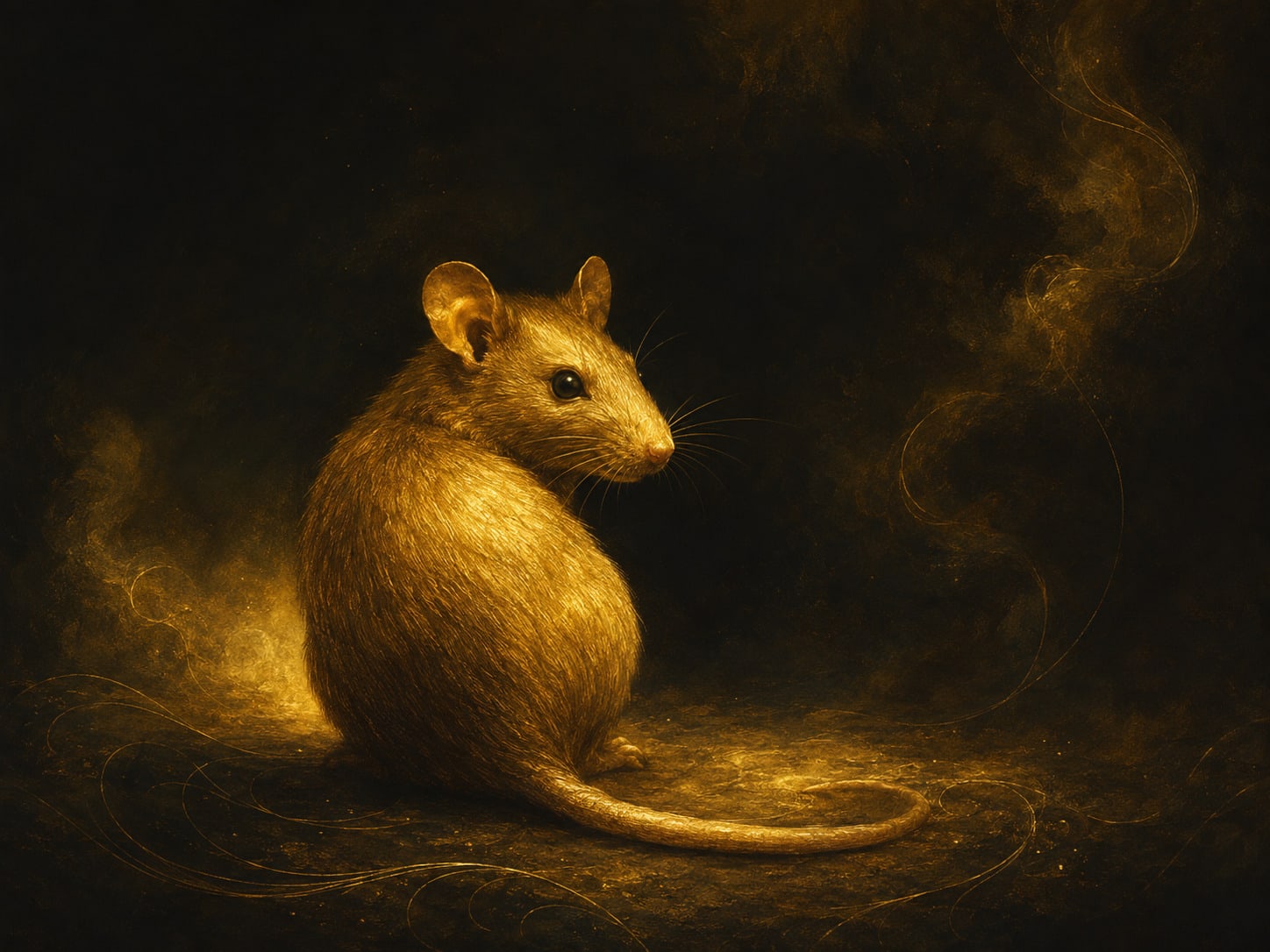
Elsewhere the animal is read positively, and this is where the assumption of disgust breaks down entirely. In Hindu iconography the mount of Ganesha is the mushika, the mouse or rat, appearing at his feet in sculpture from around the seventh century; devotional interpretation commonly reads that mount as the restless, grasping mind that intelligence rides and directs. At the Karni Mata temple in Deshnoke, Rajasthan, rats are venerated as kabbas, believed by devotees to be reincarnated members of the Charan community, and it is held to be a blessing when one runs across your feet. In the Chinese zodiac the rat is first of the twelve animals, said in the traditional story to have taken first place by cleverness rather than strength, and people born in rat years are traditionally called quick-witted and resourceful.
The same animal, then, is filth in one tradition and blessing in another, which is the clearest sign that the meaning is carried by the culture rather than the creature. Our look at how different cultures interpret dreams follows that thread.
07When the dream repeats or leaves you shaken
A rat dream that comes back tends to be tracking something unresolved rather than escalating, which is common with worries that have not been settled or even properly named. Look for the stuck thing in waking life rather than a stronger reading of the image. Our piece on why recurring dreams repeat covers the pattern in more depth. Two habits help: write the dream down with the first person or situation you thought of on waking, since that association fades fast and is the most useful part, then deal with the literal version if there is one.
If rat dreams are frequent, frightening, or leaving you anxious about going to bed, treat that as a sleep and wellbeing matter rather than a symbol to crack. Persistent nightmares respond well to help, and a distressing dream that will not let go is a reasonable thing to raise with a qualified clinician.
08Common questions about rat dreams
What is the spiritual meaning of a rat?
The traditions genuinely disagree, so there is no single answer. Modern spiritual writers usually read the rat as a prompt about survival, resourcefulness, or something needing to be cleared out, which is a reflective belief rather than a finding. Hindu tradition holds the mouse or rat as Ganesha's mount and reads it as the restless mind that intelligence directs, while Chinese tradition places the rat first among the zodiac animals for its cleverness. All of that is belief, and none of it establishes that anything will happen.
What is the biblical meaning of a rat in a dream?
The Bible does not interpret rat dreams. It mentions the animal elsewhere: Leviticus 11:29 lists the rat among unclean creatures, Isaiah 66:17 names those who eat rats and other unclean things, and 1 Samuel 6 describes the Philistines sending five gold rats as a guilt offering. Christian readers sometimes reflect on themes of uncleanness or spoiled provision from those passages, held as devotional reflection. The bad-omen readings common on ministry sites are the belief of those authors.
Is seeing a rat good luck?
It depends whose tradition you ask, and both answers are beliefs. In much of Western folklore the rat is an unlucky sign of decay or desertion, which is where the sinking-ship proverb comes from. At the Karni Mata temple in Rajasthan the rats are venerated and it is held to be a blessing if one runs over your feet, and the Chinese zodiac treats the rat as a clever, favorable start to the cycle. No evidence shows a rat dream changes what happens to you.
Do rats represent anxiety?
Often, yes, in the ordinary sense that anxious people dream about what unsettles them, and the rat is an efficient image for a worry that keeps nibbling rather than striking. This is a pattern people report, not a measured finding, and the direction matters: the anxiety comes first and supplies the image, so the dreams tend to cluster during a stressful stretch and ease when it passes.
What does it mean to dream of rats in your house?
The emotional core is intrusion rather than infestation. A house stands for the part of life meant to be private and secure, so rats indoors commonly appear when a boundary has given way: information that traveled further than you meant, access given to the wrong person, or money leaving in a way nobody can explain. Check the literal possibility first, then ask what has recently got past a line you thought was holding.
Test your rat dream knowledge
Why does the English word rat matter for these dreams?
What did the 2021 UK Library Study by Schredl and Blagrove actually find?
How should a rat dream about a specific person be treated?
Pick an answer to begin.
Whatever brought you here, a rat dream is worth reading as a question about your own unease rather than a verdict on somebody else. DreamTold treats dreams as a window into your own mind, so if another image from the same night stayed with you, look it up in the dream dictionary, and our roundup of the most common dreams and what they mean sets this one beside the images almost everyone has. This guide is educational and meant for reflection, not medical advice. If frightening dreams or lost sleep are affecting your daily life, speak with a qualified clinician.
Dream terms
Tap a term to see what it means.
Day residue. Fragments of the previous day or two that reappear in a dream, which is why a real pest problem so often turns up overnight.
Dream symbol. A recurring image people attach meaning to, shaped by language and culture rather than carrying one fixed meaning of its own.
Content analysis. The research method of coding what actually appears in collected dream reports, used to count how often animals show up.
Nightmare. A frightening dream that wakes you or leaves distress on waking, and the category most attacking-animal dreams belong to.
Recurring dream. A dream that returns in much the same form, commonly linked to a worry that has not been resolved or clearly named.
09Sources
Every claim on this page that comes from somewhere else, with the somewhere else. Scripture and hadith are linked so you can read them in context rather than trusting a paraphrase.
- BibleGateway: 1 Samuel 5:6
- BibleGateway: 1 Samuel 6
- BibleGateway: Isaiah 66:17
- BibleGateway: Leviticus 11:29
- Ibn Sirin dictionary (PDF): Ibn Sirin
Related
articles.

Fruit in Dreams: Ripe, Rotten, and What Each Is Read As
Fruit in dream meaning depends on ripe, rotten or out of season, and on who handed it to you. Jewish, Christian, Islamic and Indian readings, all attributed.
Read: Fruit in Dreams
House Dream Meaning: Rooms, Doors, and the Shape of the Self
What house dreams mean: the house as a picture of the self, what Jung actually dreamed, room by room conventions, unfamiliar houses, and the childhood home.
Read: House Dream Meaning
Lion Dream Meaning: Power, Courage, and What You Are Facing
A lion in a dream points to power. The useful question is whose: a force bearing down on you, or your own strength. Scenes, scripture, and honest limits.
Read: Lion Dream Meaning